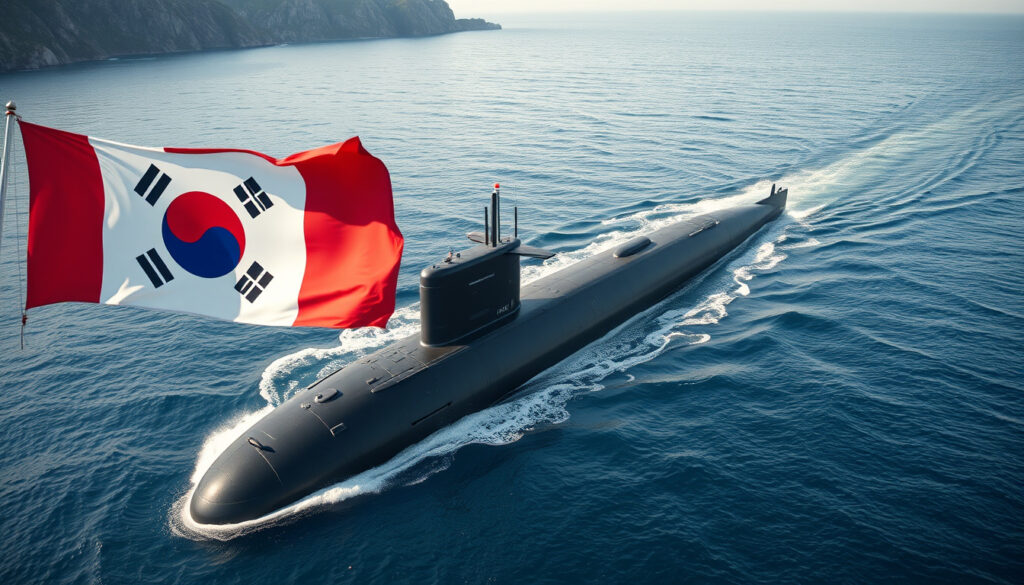
South Korea Submarine Offer to Canada: $42B Bid Details
Canada’s underwater defense needs are reshaping a $42 billion decision—and two major shipbuilders are competing to deliver. South Korea’s Hanwha Ocean, backed by whole-of-government support, is pitching its KSS-III Batch-II against Germany’s TKMS Type 212CD. This article breaks down both proposals, their technical differences, and what’s at stake for Canada’s naval future.
Deal value: $42 billion (60 trillion won) ·
Korean bidder: Hanwha Ocean (KSS-III Batch-II) ·
German bidder: TKMS (212CD) ·
Proposed subs: 4 by 2035 ·
Project name: Canadian Patrol Submarine Project
Quick snapshot
- Hanwha qualified as CPSP supplier (August 2025) (PCL Construction)
- KSS-III meets all High-Level Mandatory Requirements (PCL Construction)
- South Korea mobilized national support (February 20, 2026) (Naval News)
- Exact proposal submission dates beyond early March 2026
- Final decision timeline
- Detailed cost comparison between KSS-III and 212CD
- Status of bid sweeteners
- February 2026: Hanwha proposes 4 subs by 2035
- April 2026: South Korea interagency review
- Ongoing: Defence Investment Agency industry input
- Canada reviewing and potentially requesting improved offers
- Decision expected after full proposal evaluation
- Potential split purchase option under consideration
Key parameters for Canada’s submarine competition.
| Label | Value |
|---|---|
| Project value | 60 trillion won ($42 billion) |
| Korean proposal | KSS-III Batch-II, 4 units by 2035 |
| Competitor offer | 212CD from TKMS |
| Latest meeting | South Korea interagency review (April 2026) |
| Canada’s ask | Sweeten bids |
Who will Canada buy submarines from?
Two bidders remain in the running for Canada’s largest naval procurement in decades. Hanwha Ocean from South Korea and TKMS (ThyssenKrupp Marine Systems) from Germany are competing for the Canadian Patrol Submarine Project, which aims to replace the aging Victoria-class fleet.
South Korean consortium bid
Hanwha Ocean has assembled an aggressive campaign backed by South Korea’s entire government apparatus. On February 20, 2026, South Korea formalized a national framework to support its CPSP bid through DAPA (the Defense Acquisition Program Administration), according to Naval News. The Hanwha team signed MOUs with Algoma Steel, Telesat, MDA Space, Cohere, and PV Labs on January 27, 2026, offering up to USD $250 million for steel mill and CPSP purchases, as documented by Hanwha. The company proposes delivering 4 KSS-III submarines before 2035, with the full 12-sub fleet completed by 2043 at a rate of one per year.
Hanwha’s strategy hinges on industrial participation: Canadian firms benefit directly, not just from shipbuilding but from steel supply, satellite infrastructure, and radar technology partnerships worth hundreds of millions.
German-Norwegian joint project
TKMS is offering the Type 212CD, a design optimized for stealth in northern littoral waters with NATO interoperability. Canada signed a trilateral letter of intent with Germany and Norway for the Type 212CD in summer 2025, as noted in independent analysis. The 212CD has been exported to over 20 nations, giving it a proven track record in allied navies. However, the German-Norwegian bid emphasizes NATO ties rather than Canadian industrial content.
How many submarines does Canada have now?
The Royal Canadian Navy operates four Victoria-class submarines, all of which have faced persistent maintenance challenges and availability issues.
Current fleet status
The Victoria-class boats—HMCS Victoria, HMCS Windsor, HMCS Corner Brook, and HMCS Chicoutimi—have spent more time in maintenance than at sea. Early retirement of these vessels could save approximately $1 billion in maintenance costs, according to Hanwha’s analysis. The fleet’s limited availability has created gaps in Canada’s ability to maintain a continuous underwater presence across three oceans.
Retirement plans
CPSP began in 2021 to replace this fleet with up to 12 new submarines, according to Wikipedia. The CPSP timeline aims to have new submarines operational before the Victoria-class reaches the end of its service life. Hanwha claims it can deliver the first KSS-III within six years of contract award, per KSS-III.ca. This accelerated timeline could allow Canada to retire the Victoria-class earlier, redirecting maintenance funds toward the new fleet.
Where did Canada get their submarines?
Canada’s current submarine fleet has British roots but has operated under Royal Canadian Navy command since the early 2000s. The submarines were acquired second-hand from the United Kingdom and underwent extensive refits to extend their service life.
Previous acquisitions
Canada purchased the four Upholder/Victoria-class submarines from the UK between 1993 and 1998, with the first vessel entering Canadian service in 2001. The purchase price was relatively low, but subsequent maintenance costs have far exceeded initial expectations.
Victoria-class origins
The Victoria-class originated as the UK’s Upholder-class, designed for coastal operations rather than the long-endurance blue-water missions Canada requires. This design mismatch has contributed to operational limitations, particularly in Arctic waters where Canada’s defense priorities increasingly focus.
This history explains why CPSP requirements are so demanding: Canada can’t afford another fleet built for different operational conditions. Both current bidders know they’re pitching submarines that must excel in Atlantic, Pacific, and Arctic environments simultaneously.
How many submarines does South Korea have?
South Korea operates one of the largest and most advanced conventional submarine fleets in the Asia-Pacific region. The Republic of Korea Navy fields multiple classes, with the KSS-III series representing its most capable blue-water assets.
Fleet composition
South Korea’s submarine force includes the KSS-I (Type 209), KSS-II (Type 214), and KSS-III classes, totaling around 15-20 boats depending on operational availability. The KSS-III Batch II being offered to Canada displaces approximately 3,600 tonnes, making it significantly larger than its German competitor, per independent technical analysis.
Capabilities
The KSS-III features a 10-cell vertical launch system (VLS), lithium-ion batteries, and six 533mm torpedo tubes. Its larger hull provides more reserve buoyancy for Arctic sail strengthening, according to technical assessment. The submarine is in active production and reported to have the longest submerged endurance for anti-submarine warfare and anti-surface missions among conventional designs.
What is South Korea’s submarine offer to Canada?
Hanwha Ocean’s proposal centers on delivering operational capability quickly while building Canadian industrial participation. The offer includes not just submarines but a comprehensive partnership framework involving domestic firms across multiple sectors.
Hanwha Ocean proposal details
Hanwha Ocean was selected as a qualified supplier for CPSP in August 2025, according to PCL Construction. The company signed an MOU with PCL Construction on November 10, 2025, for CPSP infrastructure development. Hanwha’s proposal promises four submarines before 2035, with subsequent vessels delivered at one per year until the full fleet of 12 is complete. The KSS-III meets all High-Level Mandatory Requirements including Arctic deployability, per official documentation.
Delivery timeline
Hanwha can deliver the first KSS-III within six years of contract award, according to KSS-III.ca. This timeline would allow Canada to begin replacing the Victoria-class significantly earlier than traditional submarine procurement schedules. Hanwha’s industrial alliances with Canadian firms aim to build domestic capability for maintenance and sustainment, reducing long-term operational dependencies.
The Canadian Patrol Submarine Project seeks more than just capability, schedule, and cost compliance—it requires economic and industrial benefits for Canada, as Naval News reports. Hanwha’s strategy directly addresses this by embedding Canadian companies in the supply chain from day one.
Three critical differences separate the two final contenders in Canada’s submarine competition.
| Specification | Hanwha KSS-III Batch II | TKMS Type 212CD |
|---|---|---|
| Displacement | 3,600 tonnes | 2,500 tonnes |
| VLS cells | 10 | None |
| Battery type | Lithium-ion | AIP fuel cell |
| Torpedo tubes | 6 × 533mm | 6 × 533mm |
| Design focus | Blue-water endurance | Stealth/littoral |
| NATO interoperability | Standard | Enhanced |
| Export record | New export market | 20+ nations |
| Proposed delivery | 4 by 2035 | Gradual |
Key technical specifications for the Canadian Patrol Submarine Project bidders.
| Parameter | KSS-III Batch II | Type 212CD |
|---|---|---|
| Length (approx.) | ~85m | ~74m |
| Beam (approx.) | ~9.6m | ~7m |
| Surface displacement | ~3,600t | ~2,500t |
| Propulsion | Diesel-electric + lithium-ion | Diesel-electric + AIP |
| Weapon modules | VLS + tubes | Tubes only |
| Arctic capability | Enhanced buoyancy | NATO cold-water rated |
| Production status | Active (in service) | Active (multiple navies) |
| First delivery (claimed) | 6 years post-contract | TBD |
Upsides
- Hanwha offers faster delivery schedule with first vessels by 2035
- Extensive Canadian industrial partnerships worth hundreds of millions
- KSS-III larger hull better suited for Arctic operations
- VLS provides land-attack capability the 212CD lacks
- Substantial upfront investment in Canadian steel and technology firms
Downsides
- KSS-III lacks NATO battlegroup experience of 212CD
- New export market—limited long-term operational data
- TKMS has 20+ navy references vs. Korean domestic fleet only
- 212CD optimized for the stealth-first missions Canada may prioritize
- Geopolitical considerations: NATO ally vs. non-member supplier
Timeline
The Canadian submarine competition has moved quickly from initial shortlisting to active government-level campaigning.
| Date | Event |
|---|---|
| 2021 | CPSP procurement initiative begins |
| August 2025 | Canada shortlists TKMS 212CD and Hanwha KSS-III |
| Summer 2025 | Canada signs trilateral LoI with Germany/Norway for Type 212CD |
| November 10, 2025 | Hanwha signs MOU with PCL Construction |
| January 27, 2026 | Hanwha signs MOUs with Algoma, Telesat, MDA Space, Cohere, PV Labs |
| February 20, 2026 | South Korea signs national support framework for CPSP |
| March 2026 | CPSP Partners’ Day in Ottawa |
| April 2026 | South Korea interagency review meeting |
The implication: South Korea’s coordinated push over just six months shows how seriously Seoul views this contract, while Canada’s parallel engagement with Germany signals it hasn’t made up its mind.
Confirmed and Unconfirmed
The facts on record versus what remains uncertain in Canada’s submarine competition.
Confirmed
- Hanwha proposal for 4 subs by 2035
- Korean ministries reviewing bid strategies
- TKMS offering 212CD design
- Canada shortlisted both bidders
- Industrial partnership agreements signed
Unclear
- Final winner
- Exact delivery schedule details
- Bid sweeteners specifics
- Split purchase viability
- Final decision timeline
What experts say
The KSS-III is the only conventional submarine that can meet all of Canada’s requirements.
— Michael J. Lalonde, independent defense analyst (Technical Assessment)
CPSP represents an opportunity to build long-term industrial partnerships that deliver real value for Canada.
— Glenn Copeland, CEO, Hanwha Defence Canada (Naval News)
Hanwha Ocean has the fastest delivery schedule, able to deliver four KSS-III submarines to fully replace Canada’s current Victoria-class fleet before 2035.
— Hanwha Ocean (Official Statement)
What this means: The expert consensus tilts toward Hanwha on delivery speed and industrial content, but analysts have reservations about a non-NATO supplier for a program of this strategic importance.
Hanwha’s industrial package is compelling—but it’s a new export customer, not a proven NATO ally. TKMS comes with 20+ navy references and trilateral government backing, yet may struggle to match the Canadian content Hanwha is bringing.
Summary
Canada stands at a decision point that will shape its underwater defense capabilities for decades. Hanwha Ocean has mobilized South Korea’s government behind a proposal that combines rapid delivery, substantial industrial investment, and a submarine design explicitly validated for Canadian requirements. TKMS counters with NATO interoperability, an established export record, and the credibility of a traditional ally.
For the Royal Canadian Navy, the stakes are concrete: whoever wins delivers the boats that will patrol three oceans, including Arctic waters the current Victoria-class was never designed to handle. Canada has asked both bidders to improve their offers, signaling that neither proposal has yet sealed the deal.
Related reading: Toronto Raptors vs Lakers · Tesla Model Y 2025 Price
youtube.com, youtube.com, navalreview.ca, defencehub.live, armyrecognition.com
Frequently asked questions
What is the value of Canada’s submarine procurement?
The Canadian Patrol Submarine Project is valued at approximately 60 trillion won, equivalent to $42 billion. This represents Canada’s largest naval procurement in decades.
What submarines does Hanwha Ocean offer?
Hanwha Ocean is offering the KSS-III Batch II, a 3,600-tonne blue-water submarine with 10-cell VLS, lithium-ion batteries, and six 533mm torpedo tubes. The design is in active service with the Republic of Korea Navy.
What is the timeline for Canada’s new submarines?
Hanwha proposes delivering four submarines before 2035, with the full fleet of 12 operational by 2043 at one vessel per year. TKMS has not publicly committed to a comparable delivery schedule.
Why is Canada replacing its submarines?
The four Victoria-class submarines have experienced chronic maintenance issues and limited availability. CPSP, which began in 2021, aims to replace them with a more capable fleet able to operate across Atlantic, Pacific, and Arctic waters simultaneously.
How does the Korean bid compare to the German one?
The KSS-III is larger (3,600t vs 2,500t), faster to deliver, and includes VLS for land-attack capability the 212CD lacks. The Type 212CD offers superior stealth for littoral operations and has 20+ navy export references. The Korean bid includes extensive Canadian industrial partnerships; the German bid emphasizes NATO interoperability.
What is the Canadian Patrol Submarine Project?
CPSP is Canada’s initiative to replace its aging Victoria-class submarine fleet with up to 12 new patrol submarines capable of operating in Arctic, Atlantic, and Pacific waters. The project began in 2021 and has shortlisted two final bidders.
Which companies are bidding for Canada?
Two companies remain in the competition: Hanwha Ocean from South Korea (offering the KSS-III Batch II) and TKMS (ThyssenKrupp Marine Systems) from Germany/Norway (offering the Type 212CD).
More related posts
 Fallout Season 2 Release Date: Full Episode Schedule 2025
 Travis Scott’s Real Name: Jacques Bermon Webster II
 Cleaning Service Near Me: Prices, What to Expect & How to Choose
 Why Is It Called Lululemon? Name Origin, Logo & Controversy
 Kevin Porter Jr Stats: Bucks Highs, Career & Injury
 Friday the 13th (2009): Reboot, Cast, Ending Guide
 How Long to Boil Potatoes for Mashed Potatoes (Perfect)
 Toy Story 4 Cast: Full Voice Actors & Characters List