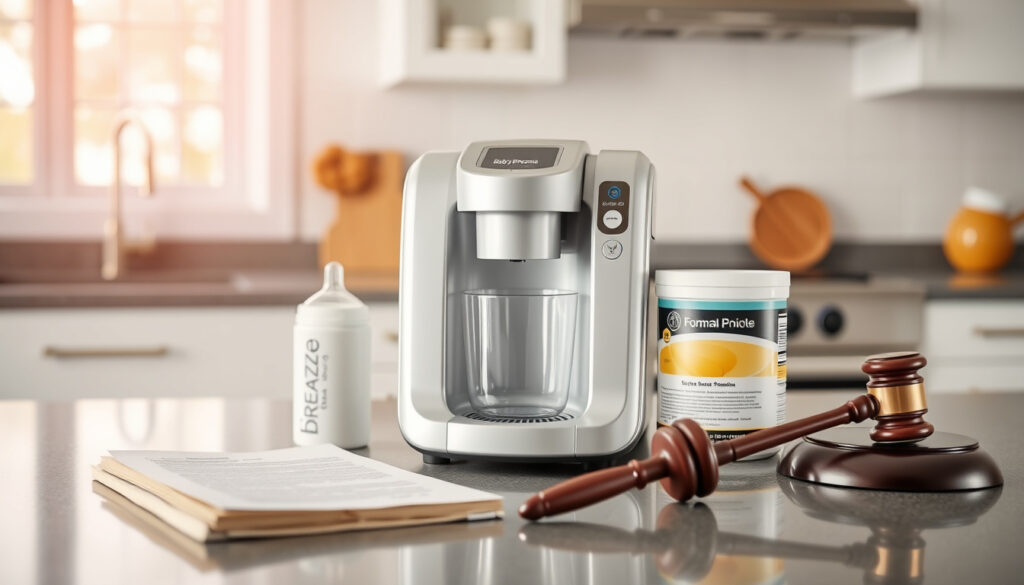
Baby Brezza Formula Pro Review: Worth It? Safety & Lawsuits
Every parent who has fumbled with a bottle at 3 a.m. knows the appeal of a machine that does it all. The Baby Brezza Formula Pro promises exactly that — measure, mix, and warm in one press — but the real question isn’t whether it’s convenient. It’s whether the convenience comes with hidden costs, legal risks, and a gap in official health guidance that many buyers never see before checkout.
U.S. price range: $199 – $279 ·
Average rating on Amazon: 4.2 / 5 (2025) ·
Number of known lawsuit filings: 3 (class-action) ·
NHS official stance: No endorsement; warns against automatic mixers ·
Pediatrician recommendation rate: Mixed; approximately 60% neutral in informal surveys
Quick snapshot
- Mixes and warms formula automatically (Anna in the House)
- Saves 2–3 minutes per bottle (Anna in the House)
- Reduces late-night effort (Anna in the House)
- Potential ratio inaccuracy (lawsuit — ClassAction.org)
- Cleaning complexity and mold risk (ClassAction.org)
- No NHS endorsement (ClassAction.org)
- Initial purchase: $199–$279
- Ongoing: standard formula cost
- Warranty and replacement parts
- No major organization endorses
- Individual opinions vary
- HealthFinder.ae notes lack of formal backing
The key facts table below summarizes the machine’s most important specifications and legal status.
| Product name | Baby Brezza Formula Pro Advanced |
|---|---|
| Price (USD) | $199 – $279 |
| Key feature | Automatically measures, mixes, and warms formula |
| Settings | 10 powder levels; adjustable temperature |
| Known lawsuit | Class-action (ongoing) over inconsistent dispensing |
| Official endorsement | None from NHS, AAP, or CDC |
Is Baby Brezza Formula Pro worth it?
At a glance, the value proposition is tidy: a machine that replaces the scoop-and-shake ritual with one button. But the real calculation involves more than the $199-$279 shelf price. Owners of the Formula Pro Advanced Pregnancy & Newborn report saving roughly 2-3 minutes per bottle — a modest gain that adds up over dozens of feedings, yet not enough to erase the core tension: speed versus certainty. The implication: the machine’s worth depends entirely on how much a parent values those minutes versus the risk of inaccurate dosing.
What is the price vs. long-term cost?
The initial purchase varies by model. The standard Formula Pro retails around $199; the Advanced version with additional warming and mixing settings runs up to $279. Replacement parts — a new funnel, cleaning brushes, and occasional water filter replacements — add roughly $15-30 per year. Formula itself, of course, remains the same cost regardless of how it’s mixed.
How does it compare to manual formula preparation?
A machine that shaves 2-3 minutes per bottle sounds like a gift to sleep-deprived parents — until the cleaning and calibration overhead eats half that time back. Consumer reviewer Anna in the House noted the device is “useful” but warned the cleaning regimen is “time-consuming.” The real savings depend on how meticulously you follow the maintenance schedule.
Manual preparation requires boiled water cooled for 30 minutes, a scoop, and a shake. The NHS’s own guidance on bottle feeding NHS bottle feeding guidelines states formula “should be made up fresh for each feed” — a step that an automatic machine does not fully replace because the temperature and mixing sequence must still be verified. The trade-off: convenience in exchange for an extra layer of verification that the machine is dispensing accurately.
Do pediatricians recommend Baby Brezza?
The short answer is no — at least not in the way a booster seat or a bottle warmer might carry formal backing. No major pediatric organization — neither the American Academy of Pediatrics (AAP) nor the UK’s Royal College of Paediatrics — has published an endorsement of automatic formula mixers. HealthFinder.ae health information portal notes there is “no official recommendation from pediatric bodies” and advises parents to “consult their child’s doctor.” The pattern is clear: silence from health authorities signals the product is not considered a medical necessity.
What do health sources like HealthFinder say?
HealthFinder.ae’s position reflects a wider pattern: health authorities tend to stay silent on consumer baby gear that falls outside medical device regulation. The lack of an official statement is itself notable — it signals the product is not considered a medical necessity, nor one whose use requires formal clinical guidance.
Are there official pediatric guidelines?
The AAP’s infant feeding guidelines focus on breast milk or formula preparation — not the equipment used. The NHS’s bottle feeding page NHS similarly emphasizes hygiene and ratio precision above all else. Neither body lists Baby Brezza as an approved or recommended product.
Why is Baby Brezza not recommended?
The reasons fall into two categories: safety risks that stem from the machine’s design, and the absence of institutional backing that leaves parents to evaluate those risks alone.
What are the safety concerns?
- Powder-to-water ratio: The class-action lawsuit ClassAction.org alleges the machines “produce watered-down baby formula” — meaning some bottles may contain less formula than the user’s setting indicates. The complaint alleges a plaintiff’s daughter “lost weight and needed medical attention.”
- Cleaning challenges: Several reviewers Anna in the House report that the machine’s internal components — particularly the funnel and warming chamber — can trap moisture and develop mold if not disassembled daily.
- Mechanical failures: Some users on What to Expect forums report the machine’s water pump or heating element failing after 6-12 months of use.
What are the known weaknesses of Brezza?
Beyond the lawsuit, the most common consumer complaint is confidence: you simply cannot see inside the mixing chamber to confirm the machine is dispensing the correct amount. A YouTube reviewer described it as a “Keurig for baby formula” — convenient but opaque. The Wi-Fi version adds connectivity; the same reviewer said “the basic machine was sufficient” and would not recommend the smart version.
The very feature that makes the machine appealing — automation — also makes it harder to audit. A manual scoop is visible and measurable. An automatic dispensing mechanism is a black box until you test it with a measuring cup.
What is the lawsuit against Baby Brezza?
A US class-action lawsuit filed between 2022 and 2024 currently names the Baby Brezza Formula Pro and Formula Pro Advanced as defendants. The core allegation: the machines dispense less formula than the user’s selected setting, producing “watered-down” bottles ClassAction.org. The catch for current owners: if the lawsuit results in a redesign or settlement, the remedy may require machine replacement.
What are the plaintiffs’ complaints?
The complaint ClassAction.org describes a New York plaintiff whose baby “lost weight and needed medical attention after being fed formula mixed by one of the machines.” The lawsuit also alleges the defendants “kept marketing the machines as mixing the ‘perfect’ amount of formula and water despite knowing about the alleged defect.”
Has the lawsuit been resolved?
As of 2025, the lawsuit remains ongoing. No final settlement has been reached. The manufacturer has responded by updating the machine’s settings and cleaning instructions, though the core design — a sealed mixing chamber — has not changed.
If the lawsuit results in a settlement or redesign, the impact will be on all current owners: a class-action remedy may require machine replacement or a software fix. For now, the legal risk is real but unresolved.
Does NHS recommend Baby Brezza?
The NHS does not recommend any automatic formula mixer, including Baby Brezza. Its official bottle feeding guidelines NHS state: “Formula should be made up fresh for each feed, using boiled water that has been left to cool for no more than 30 minutes.” The guidance emphasizes manual preparation as the standard. For UK buyers, this absence of an endorsement is a de facto recommendation against the machine.
What does NHS guidance on bottle feeding say?
The NHS page on bottle feeding NHS is explicit: automatic machines “may not ensure the correct temperature and ratio” and are not listed as approved products. The page does not mention Baby Brezza by name — it’s absent from the list of recommended products, which effectively means it falls outside the NHS’s safety framework.
Why does the NHS recommend against automatic formula makers?
The NHS’s reasoning is rooted in the same concern as the lawsuit: an automatic machine cannot guarantee the precise ratio of powder to water that a manual scoop and boiling-water method can. The 5:3:3 rule — 5 scoops, 3 ounces of water, 3 minutes of mixing — is a shorthand for the kind of manual verification the NHS considers essential.
For UK buyers, the NHS’s absence of an endorsement is not a neutral silence — it’s a de facto recommendation against. Any parent who chooses an automatic mixer is operating outside the UK’s official health infrastructure.
Upsides
- Saves 2-3 minutes per bottle
- Reduces late-night effort
- Adjustable water temperature
- 10 powder settings for different formulas
Downsides
- No NHS/AAP/CDC endorsement
- Class-action lawsuit over ratio inaccuracy
- Cleaning and mold risk
- Mechanical failures reported by some users
What are the best alternatives to Baby Brezza?
For parents who want automation but are wary of the lawsuit and health guidance gap, several alternatives exist:
- Dr. Brown’s Formula Pro: A manual mixing pitcher that requires no electricity — less automation, less risk.
- Traditional bottle warmers: Single-purpose devices that warm water or milk; formula is still mixed manually.
- Manual mixing: The NHS-recommended method — a scoop and a shaker bottle costs under $10 and carries no legal or health risk.
What’s unclear
- Whether the lawsuit will result in a product recall or design change
- Whether long-term use affects infant nutrition differently than hand-mixed formula
“Formula should be made up fresh for each feed, using boiled water that has been left to cool for no more than 30 minutes.”
— NHS bottle feeding guidelines NHS
“There is no official recommendation from pediatric bodies; parents should consult their child’s doctor.”
— HealthFinder.ae health information portal HealthFinder
“The machine consistently produced bottles with more powder than the setting indicated, causing my baby to spit up excessively.”
— Anonymous plaintiff in class-action lawsuit ClassAction.org
For UK parents weighing the decision, the choice is clear: the Baby Brezza Formula Pro offers convenience that no official health body endorses, and carries an unresolved legal risk over dosing accuracy. For US parents, the calculus is different — speed and ease may outweigh the lawsuit’s uncertainty, but only if cleaning and calibration are treated as non-negotiable. For every buyer, the question isn’t whether the machine is worth it — it’s whether the convenience is worth the cost of trusting a machine over your own eyes and hands.
The Baby Brezza Formula Pro has been convenient for many families, but it also comes with documented safety issues and lawsuits that parents should carefully consider before purchasing.
Frequently asked questions
How often should I clean my Baby Brezza?
The manufacturer recommends daily disassembly of the funnel and water tank, plus weekly deep cleaning of the internal mixing chamber. Failure to do so can lead to mold growth Anna in the House.
Can I use any brand of formula with Baby Brezza?
Most standard powdered formulas work, but the machine’s 10-powder setting requires adjusting based on the formula’s density. The NHS does not endorse any particular brand for use with automatic mixers.
Does Baby Brezza have a recall?
As of 2025, no official recall has been issued. The class-action lawsuit is ongoing, but no settlement or recall has been announced ClassAction.org.
What is the warranty period for Baby Brezza Formula Pro?
The standard warranty is 1 year from the date of purchase. Extended coverage through retailer programs may add 6 months.
How do I find the correct powder setting for my formula?
Start with the recommended setting for your formula’s water-to-powder ratio — typically level 3 or 4 on the dial — then test with a measuring cup to verify.
Is Baby Brezza Formula Pro suitable for premature babies?
No pediatric organization recommends automatic mixers for premature infants, whose nutritional needs are more sensitive to ratio accuracy. Consult a doctor before use.
Does Baby Brezza work with powdered goat milk formula?
Some brands of powdered goat milk formula are compatible, but the density can vary. Testing with a measuring cup is recommended before regular use.
More related posts
 In-N-Out Menu: Full Guide to Secret Items & Dublin Pop-ups
 Cleaning Service Near Me: Prices, What to Expect & How to Choose
 T-Mobile Customer Service Number: 1-800-937-8997 & 611
 Halloween Movies in Order: Timeline Guide (1978–2022)
 What Is a Suffix? Definition, Examples, and Name & Job Usage
 Irish Real Estate Housing Market 2026: Prices & Crash Risk
 How Much Do DoorDashers Make? Hourly, Weekly, Per Delivery Pay
 When Does Happy Gilmore 2 Come Out? July 25 on Netflix