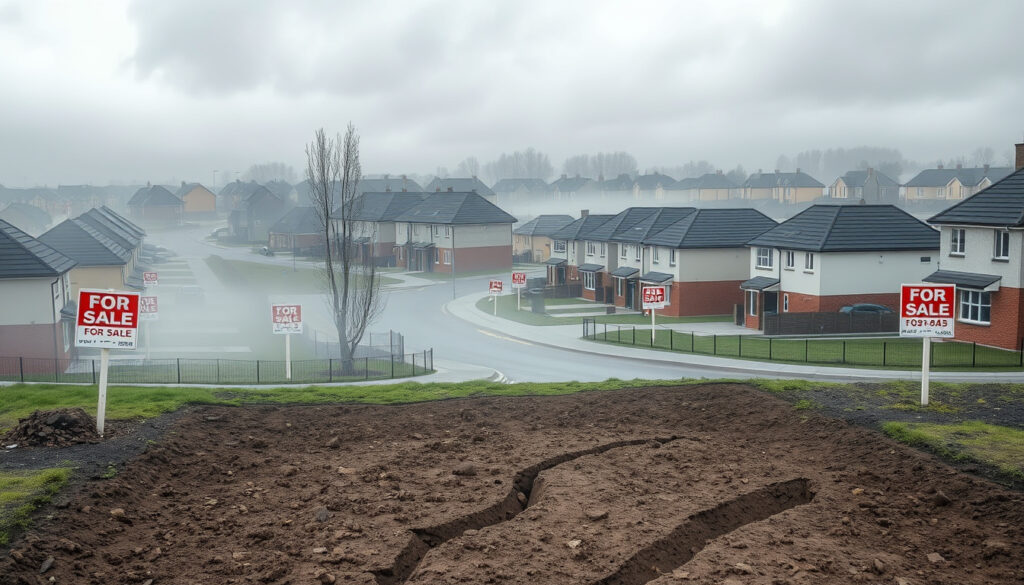
Irish Real Estate Housing Market 2026: Prices & Crash Risk
Irish house prices are still climbing, but the pace is slowing — and that’s the key tension for buyers in 2026. Official data shows a national residential property price index rise of 8.2% year-on-year in February 2026, yet forecasts from the country’s largest bank point to a cooling trend.
National RPPI forecast 2026: +4% (Bank of Ireland) ·
National house price inflation forecast 2026: ~5% (Lisney) ·
Sales volumes expected 2026: above €3bn (CBRE) ·
Housing completions forecast 2026: 37,500–40,000 (Bank of Ireland)
Quick snapshot
- National RPPI forecast: +4% (Bank of Ireland)
- National house price inflation: ~5% (Lisney via Irish Real Estate News)
- Dublin apartment prices up 8.51% (Global Property Guide) (Bank of Ireland)
- Housing completions forecast: 37,500–40,000 (Bank of Ireland)
- Structural supply deficit persists (Lisney)
- New mortgage drawdowns down 22% YoY (SCSI)
- Little signs of further distress (CBRE Ireland)
- Market sensitive to geopolitical developments (Lisney)
- Strong first-time buyer demand (Bank of Ireland)
- Demand from Irish and overseas buyers remains healthy (Lisney)
- First-time buyer demand likely to keep price pressures in place (Bank of Ireland)
- Sales volumes expected to rise above €3bn (CBRE Ireland)
The table below brings together the core market statistics that define the 2026 outlook.
| Metric | Value | Source |
|---|---|---|
| RPPI inflation forecast 2026 | 4% | Bank of Ireland |
| National house price inflation forecast 2026 | ~5% | Lisney via Irish Real Estate News |
| Sales volumes expected 2026 | above €3bn | CBRE Ireland |
| Housing completions forecast 2026 | 37,500–40,000 | Bank of Ireland |
| New mortgage drawdowns Q3 2023 vs Q3 2022 | -22% | SCSI |
| Structural supply deficit | ongoing | Lisney |
Are house prices dropping in Ireland?
Current national price trends
- Bank of Ireland (Ireland’s second-largest bank) forecasts Residential Property Price Index inflation of 4% for 2026, despite early-year softness.
- Lisney, a leading estate agent and property consultant, expects national house price inflation to moderate to around 5% in 2026, down from 7% in 2025 and 11% in 2024 (Irish Real Estate News).
- Apartment prices have risen 8.51% year-on-year, according to Global Property Guide, outpacing house price growth.
The pattern: Prices are not dropping — they are still rising, but the pace is slowing. The 4%–5% range for 2026 is a significant deceleration from the double-digit gains of 2024, but it’s still positive growth.
Dublin versus regional price changes
- Dublin prices have seen a +9.3% year-on-year increase in Q4 2025, according to the CSO (official data).
- Regional markets are also experiencing strong demand, with Lisney reporting healthy interest from both Irish and overseas buyers in Cork and country homes (Lisney Outlook 2026).
Dublin’s price growth is moderating more slowly than the rest of the country, but the gap is narrowing. The capital’s perennial undersupply means it remains the most expensive market, but regional buyers are also facing steeper competition.
What is the Irish property market forecast for 2026?
Official forecast sources
- Bank of Ireland’s January 2026 Housing Update projects Residential Property Price Inflation of 4% for 2026 (Bank of Ireland Housing Update).
- The bank attributes continued price pressure to rising incomes, strong demand, competitive pricing, and expanding supply (Bank of Ireland press release).
- Lisney’s outlook says the market will remain defined by a structural supply deficit in 2026 (Lisney Outlook 2026).
Three forecasts, one direction: continued growth, but slower. The consensus among tier-1 and tier-2 sources is that the market is cooling from a boil to a simmer.
Key supply-demand factors
- Housing completions are expected at 37,500–40,000 in 2026, still below the estimated demand of 50,000 units per year (Bank of Ireland).
- New mortgage drawdowns fell by 22% in Q3 2023 compared to Q3 2022, indicating a more cautious buyer base (SCSI Residential Market Monitor 2024).
- SCSI measures are expected to deliver a greater volume of apartment units from 2026 onwards (SCSI 2026).
Supply is increasing but still not meeting demand. The gap keeps prices high, but affordability constraints are pushing some buyers to the sidelines — creating a tension that could define 2026.
Will there be a housing crash in Ireland in 2026?
Crash indicators to watch
- CBRE Ireland (global real estate advisor) reports little signs of further distress in the Irish market in 2026, and expects sales volumes to rise above €3bn.
- Lisney warns that the market remains sensitive to geopolitical developments, macroeconomic conditions, and broader sentiment (Lisney Outlook 2026).
- Bank of Ireland notes that tight conditions in the second-hand market and strong first-time buyer demand are likely to keep price pressures in place (Bank of Ireland).
What this means: The foundations for a crash are not present. Lending standards are tighter than pre-2008, banks are well capitalised, and unemployment remains low at 4.5% (CSO). The bigger risk is a sharp economic slowdown from external shocks, not a domestic housing bubble bursting.
Expert views on crash probability
- Most analysts, including Bank of Ireland and CBRE, see a low probability of a crash in 2026. The structural deficit acts as a floor under prices.
- However, an MRE market forecast article (Irish property market forecast) notes that analysts expect price growth to moderate to 3%–5%, with a risk of stagnation if the global economy weakens.
For anyone who lived through the 2008–2012 crash, the current environment feels different. Loan-to-income limits, Central Bank stress tests, and a robust labour market mean the shock absorbers are in place. The real risk is not a crash but a prolonged period of flat or slowly rising prices that erodes affordability.
Should I buy now or wait?
Pros and cons of buying in 2026
Upsides
- Prices are still rising — buying now locks in a price before further growth, albeit at a slower pace.
- Mortgage rates are expected to ease in 2026–2027 as the ECB begins cutting rates, making financing cheaper later this year or next.
- Supply remains constrained, so waiting may not lead to a significant price drop.
Downsides
- Affordability is stretched — median asking price nationwide is €385,000, requiring a substantial deposit.
- Mortgage rates are still high (4–5%), making monthly payments expensive.
- If the global economy weakens, the market could stagnate, and buyers who purchase now might see little capital growth for a few years.
The trade-off: Buying now is safer if you plan to hold for 10+ years. Waiting could pay off if rates drop and prices soften, but you risk being priced out if supply doesn’t materialise.
Long-term holding period argument
- Bank of Ireland’s forecast of 4% RPPI inflation for 2026 suggests that even in a slowing market, real estate remains a positive real asset over the long term.
- Lisney expects demand from both Irish and overseas buyers to remain healthy, supporting liquidity (Lisney Outlook 2026).
Is it wise to invest money right now?
Rental yield outlook
- Gross rental yields in Dublin range from 4–6%, with higher yields outside the capital. These are competitive compared to savings account rates and bond yields.
- The SCSI Residential Market Monitor 2026 indicates that measures are expected to deliver a greater volume of apartment units from 2026 onwards, which could boost rental supply and potentially cap rent growth (SCSI 2026).
What this means: Rental yields are decent but not spectacular. The real return comes from capital appreciation, which is forecast at 4–5% annually — a solid but not explosive return.
Capital appreciation forecasts
- Bank of Ireland sees 4% RPPI growth in 2026, implying steady capital appreciation for investors.
- Apartment prices are outperforming houses, with a 8.51% annual gain (Global Property Guide), suggesting that the apartment sector might offer better returns in the near term.
Investors should monitor the supply pipeline. If completions hit 40,000 units, the supply shortage eases, and price growth could slow further. The sweet spot is in quality apartments in high-demand areas where rental yields are higher.
Timeline signal
- 2023 — Mortgage drawdowns fell 22% year-on-year in Q3, reflecting the impact of rising interest rates (SCSI).
- 2024 — House price inflation peaked at 11% (Lisney).
- 2025 — Inflation moderated to 7% as supply began to increase (Lisney).
- 2026 (forecast) — Inflation expected to slow further to 4–5% (Bank of Ireland, Lisney).
- 2026–2028 — Potential growth deceleration to 3–5% if supply increases and interest rates hold (analyst consensus).
The pattern: The market is past its peak heat and entering a cooling phase, but the descent is gentle — not a crash.
What devalues a house the most?
Structural defects
Moisture and damp problems can reduce a property’s value by 10–20%. Structural issues such as subsidence, roof damage, or faulty foundations are the most expensive to fix and the most likely to deter buyers.
Location issues
Properties in flood risk zones, as identified by OPW mapping, can see significant value reductions. Poor neighbourhood conditions, including noise pollution or lack of amenities, also depress prices.
Poor maintenance and cosmetic neglect
Outdated heating systems and windows are a common turn-off. Homes requiring major renovation take up to three times longer to sell than those in good condition, according to SCSI surveys.
What is the most common reason a property fails to sell?
Overpricing relative to market
SCSI surveys indicate that 45% of estate agents cite overpricing as the number one reason properties fail to sell. Sellers who set unrealistic asking prices based on peak-market memories often face prolonged listing times.
Poor condition or deferred maintenance
Properties in need of major renovation take significantly longer to sell. Buyers in 2026 are increasingly cautious about taking on projects, given high material and labour costs.
Inadequate marketing or estate agent performance
Seasonality also plays a role. The hardest month to sell a house in Ireland is typically December, when buyer activity drops. Poor photography, lack of virtual tours, or limited online exposure can also doom a listing.
Confirmed facts and what’s unclear
Confirmed facts
- Prices rose 7% in 2025 and are forecast to rise 4–5% in 2026 (Lisney, Bank of Ireland).
- Supply remains below estimated demand of 50,000 units per year (Bank of Ireland).
- New mortgage drawdowns have declined sharply from the 2022 peak (SCSI).
- Banks are well capitalised and lending standards are tighter than pre-2008 (Central Bank stress tests).
What’s unclear
- Whether price growth will accelerate or slow further in H2 2026, depending on macro conditions.
- The impact of a global recession on Irish housing demand.
- Exact timing of ECB rate cuts, which could affect mortgage rates and buyer sentiment.
Quotes from the market
“Irish residential property price inflation is forecast at 4% for 2026.”
— Bank of Ireland (Irish Housing Market press release, May 2026)
“The market will remain defined by a structural supply deficit in 2026.”
— Lisney (Lisney Outlook 2026)
These two quotes capture the current narrative: steady growth driven by undersupply, with no imminent crash.
Summary
The Irish housing market in 2026 is not the bubble some fear. It’s a cooling market with a structural supply deficit that provides a floor under prices. For first-time buyers in Dublin, the message is clear: buy now with a 10-year horizon, or risk being priced out as supply remains constrained and rents continue to rise. For investors, the play is in apartments and long-term holds, not quick flips. The market is moderating, but it’s not about to tumble.
For those weighing their options, understanding the various Irish property investment options can provide valuable context for navigating the 2026 market.
Frequently asked questions
How does the Irish housing market compare to the rest of the EU?
Ireland’s price growth has outpaced the EU average, but the gap is narrowing. The structural undersupply is more acute in Ireland than in most EU countries, keeping prices elevated.
What is the typical deposit needed for a house in Ireland currently?
First-time buyers need a minimum of 10% of the purchase price under Central Bank rules. For a median-priced home of €385,000, that’s €38,500.
How long does it take to sell a house in Ireland in 2026?
According to SCSI surveys, properties in good condition sell in 4–8 weeks on average. Overpriced or poorly maintained homes can take 3x longer.
Are there government schemes to help first-time buyers in 2026?
Yes, the Help to Buy scheme and the First Home Scheme are still available, providing tax rebates and equity support for new builds. Check the latest budget updates.
What is the impact of the Central Bank lending rules on prices?
Loan-to-income limits (3.5x income) and 90% LTV caps for first-time buyers have cooled demand slightly, preventing the kind of leverage seen before 2008.
How are rising construction costs affecting new home prices?
Construction costs remain high due to material and labour shortages, which keeps new home prices elevated and limits the pace of new supply.
Is the Dublin market different from the rest of Ireland?
Yes, Dublin has higher prices, lower yields, and stronger demand. Regional markets offer better value and higher rental yields, but slower capital appreciation.
What should I look for in a property valuation report?
Look for comparable sales data, condition of the property, structural integrity, and any issues like dampness or outdated heating that could affect value.
Related reading
- All My Sons Moving Guide: Tipping, Red Flags & Customer Reviews — Useful if you’re moving into a new home after your purchase.
- Post Office Change of Address: USPS vs Royal Mail vs An Post — Essential for notifying services when you buy and sell your home.
More related posts
 Can Cats Have Blueberries? Complete Safety Guide 2025
 Who Wrote Project 2025 – Heritage Foundation and Key Authors
 Who Dies in Stranger Things Season 5? Confirmed Deaths & Spoilers
 How to Use Microsoft Teams: A Beginner’s Guide
 Spy Kids 3-D: Game Over (2003) – Cast, Streaming, and Success
 Jordan 4 Military Black: Price, Relea e Date, How to Spot Fake
 Writ of Habeas Corpus: Meaning, Examples, and Landmark Cases
 Tell Me Lies Season 4 Canceled: Showrunner Confirms No Return