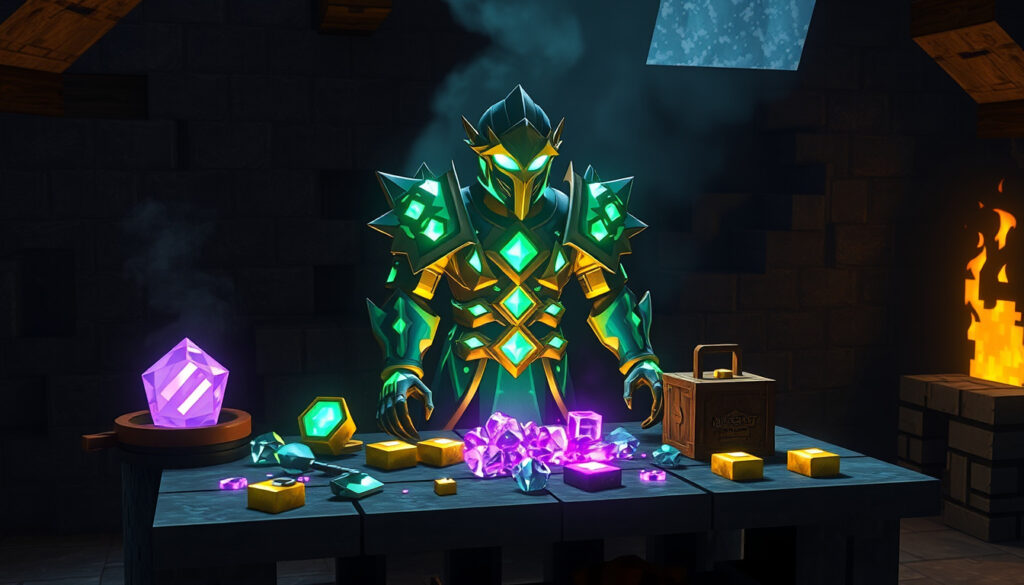
How to Make Netherite Armor in Minecraft: Step-by-Step
If you’ve spent hours equipping a full diamond set in Minecraft, you already know that feeling—until you learn what’s waiting in the Nether. Obtaining netherite armor is a multi-step process that starts deep underground, in one of the game’s most dangerous dimensions, and ends at a smithing table. This guide walks you through the entire path: finding ancient debris, converting it into ingots, grabbing the right smithing template, and upgrading your gear piece by piece.
Netherite ingots for full armor set: 4 · Upgrade base: Diamond armor · Required station: Smithing table · Key material: Ancient debris · Template needed: Netherite upgrade smithing template
Quick snapshot
- Netherite upgrades diamond gear only (Minecraft Wiki)
- Template is consumed on use but duplicable (Minecraft Wiki)
- Enchantments carry over during upgrade (Ouiheberg Gaming Guide)
- Exact spawn rate for template in bastion chests varies by seed
- Optimal mining route differs based on player experience and available resources
- Netherite introduced in version 1.16 (June 2020) (Minecraft Wiki)
- Smithing templates became required in version 1.20 (June 2023) (YouTube Armor Trim Guide)
- Process remains unchanged through current Minecraft versions
- Template duplication reduces long-term resource demand after first acquisition
The table below summarizes the core mechanics for crafting netherite gear from raw materials.
| Label | Value |
|---|---|
| Primary material | Ancient debris |
| Smelting yields | 1 netherite scrap per debris |
| Ingot recipe | 4 scrap + 4 gold |
| Armor pieces | Helmet, chestplate, leggings, boots |
How do I find ancient debris?
Ancient debris is the raw ore found only in the Nether dimension. On average, you’ll find about 2 ancient debris blocks per chunk, with a maximum of 5 per chunk reported by guides (Minecraft Wiki and Ouiheberg both note this range). The ore generates at specific Y-levels, so knowing where to dig matters more than luck.
Best Y-levels for mining
The sweet spot for finding ancient debris is Y-level 13 to 15, with Y=15 considered optimal. In Java Edition, press F3 to check your Y coordinate; in Bedrock Edition, enable coordinates in world settings. Mining at the right depth maximizes your chances per block broken.
Tools and enchantments needed
You need a diamond pickaxe or better to mine ancient debris—anything weaker will not drop the ore. Efficiency enchantments help, but the real strategy is using explosions to expose ore without destroying it, since ancient debris is explosion-proof.
Two methods dominate player guides: the bed explosion trick and TNT mining. The bed method is more accessible early-game since beds are cheap. TNT mining exposes more ore per session but requires redstone and gunpowder resources. Both are valid depending on what you have available.
How to make netherite ingot?
Making a netherite ingot requires two steps: smelting ancient debris first, then combining the resulting scraps with gold ingots at a crafting table.
Smelt ancient debris
Smelt each ancient debris block in a furnace or blast furnace to obtain netherite scrap. A blast furnace smelts twice as fast as a regular furnace, which adds up when you’re processing 16+ debris blocks for a full armor set.
Crafting recipe
Place 4 netherite scraps and 4 gold ingots anywhere in a crafting table grid to produce one netherite ingot. The exact arrangement does not matter—only that all 8 materials are present.
A full set requires 4 ingots total, meaning 16 scraps and 16 gold ingots. Plan your gold farming accordingly—piglin trading is the most reliable renewable source.
Do I need a smithing template to make netherite armor?
Yes. Since Minecraft version 1.20, a Netherite Upgrade Smithing Template is required for every upgrade. You cannot craft netherite armor directly from materials—the process always involves upgrading existing diamond gear.
Where to get netherite upgrade template
Netherite Upgrade Smithing Templates are found in chests within Bastion Remnants in the Nether. Every 432×432 block region in the Nether contains either a bastion remnant or a nether fortress, with bastions having a higher spawn chance. They appear in all Nether biomes except Basalt Deltas.
Bastion remnant locations
Bastion remnants have several structural variants—bridge,hoglin stable, treasure room, and ruined portal. The treasure room variant tends to have the highest concentration of valuable chests. Bring protection armor and be ready for piglin confrontations.
How do I upgrade my diamond armor to netherite?
Open the smithing table interface and place three items: the Netherite Upgrade Template in the left slot, the diamond armor piece you want to upgrade in the middle slot, and a netherite ingot in the right slot. The smithing table requires 4 wooden planks and 2 iron ingots to craft.
Step-by-step upgrade process
Upgrade each armor piece individually—one netherite ingot is consumed per piece. Start with your chestplate if you want maximum protection immediately, or work in whatever order feels logical to you. The upgrade preserves all enchantments, durability, and even custom names from your diamond gear, so nothing is lost in transition.
Smithing templates are consumed each time you use them. The solution is duplication: combine 1 existing template with 7 diamonds and 1 netherrack in a crafting table to create a second copy. Once you have one template, you can chain-duplicate as many as you need.
The implication: once you secure your first template, the upgrade path becomes effectively unlimited since you can replicate it indefinitely with common Nether materials.
How many pieces of netherite do you need to make a full set?
Four netherite ingots are needed for a complete armor set, one per piece: helmet, chestplate, leggings, and boots. This translates to 16 netherite scraps, requiring you to smelt 16 ancient debris blocks, and 16 gold ingots.
Materials breakdown
- Helmet: 1 netherite ingot
- Chestplate: 1 netherite ingot
- Leggings: 1 netherite ingot
- Boots: 1 netherite ingot
Total ancient debris required
At minimum, you need 16 ancient debris blocks for a full set, assuming zero waste during smelting and crafting. Most players recommend farming 20-24 blocks to account for unlucky chunks and crafting mistakes.
Netherite armor outperforms diamond across every metric—higher durability, better protection, and resistance to fire and lava. But the resource grind is substantial. Players in peaceful survival worlds may find diamond gear sufficient for most threats while saving netherite for specific hazards.
What this means: the Netherite grind rewards planning. Players who distribute the resource collection across multiple sessions—mining debris on one run, farming gold through piglin trades on another—avoid burnout better than those rushing for a full set in a single session.
Confirmed facts
- Netherite upgrades diamond gear only, using a smithing table introduced post-1.16
- One netherite ingot requires 4 netherite scraps and 4 gold ingots
- Ancient debris averages 2 per chunk, maximum 5 per chunk
- Smithing templates are consumed on use but duplicable with 7 diamonds and 1 netherrack
- The upgrade process works identically in Java and Bedrock editions
What’s unclear
- Exact loot table probabilities for templates in bastion chests vary by structure variant
- Optimal mining strategies depend heavily on player experience level and available resources
Netherite armor and tools are not crafted directly. The process is always an upgrade from diamond via the smithing table.
— Ouiheberg (Gaming Guide Author)
To upgrade your entire armor set, you’ll need 4 Netherite Ingots, which means 16 Netherite Scraps and 16 Gold Ingots.
— Godlike Host (Hosting Blog Author)
Related reading: Pokemon Games in Order · How to Unhide Apps on iPhone
youtube.com, youtube.com, godlike.host, youtube.com, youtube.com, youtube.com
Crafting Netherite ingots from ancient debris and gold sets the stage for upgrades, much like the process in Minecraft 1.21 upgrade guide using the smithing template on diamond gear.
Frequently asked questions
Can you craft netherite armor?
No. Netherite armor is created by upgrading existing diamond armor at a smithing table. You cannot craft it directly from raw materials.
How rare is ancient debris?
Ancient debris generates at about 2 blocks per chunk on average, with a maximum of 5 per chunk. This makes it rarer than diamond ore in the overworld, but the real challenge is accessing the Nether and mining at the correct Y-level.
What’s the rarest armor in Minecraft?
Netherite armor is the strongest armor in standard Minecraft, surpassing diamond. There is no rarer base armor type in the base game, though enchanted diamond gear may occasionally appear stronger before accounting for enchantment compatibility.
How to make netherite armor in Bedrock?
The process is identical to Java Edition: mine ancient debris, smelt it into scraps, craft ingots, find a smithing template, and upgrade your diamond armor at a smithing table. Enable coordinates in your world settings to find the right Y-level.
How to make netherite armor without template?
Since Minecraft 1.20, a smithing template is required. There is no workaround in current versions. Your options are finding a template in a bastion remnant chest or duplicating one you already own using diamonds and netherrack.
How to make netherite armor and tools?
The same process applies: upgrade your diamond tools and weapons using netherite ingots at the smithing table. One ingot upgrades one piece of equipment. A full set of armor plus a pickaxe, sword, and axe requires more resources than the armor alone.
How rare is ancient debris compared to diamond?
Ancient debris is less common than diamond ore on a per-chunk basis, but since it only generates in the Nether and at specific Y-levels, the effective rarity is much higher. Diamond generates in multiple overworld biomes at varying depths, while ancient debris requires venturing into one of the game’s most dangerous dimensions.
More related posts
 Pacers vs Cleveland Cavaliers Timeline | Head-to-Head History
 T-Mobile Customer Service Number: 1-800-937-8997 & 611
 All My Sons Moving Guide: Tipping, Red Flags & Customer Reviews
 Milwaukee Brewers vs Padres Match Player Stats | Game Analysis
 Party Dresses for Women in Ireland: Styles & Shops
 Jason Statham New Movie: Shelter 2026, Mutiny & Wrath of Man
 Duke Blue Devils Men’s Basketball – 2024-25 Roster, Coach & News
 iPhone 15 Pro Max Size: Dimensions, Weight & Screen