How Many mm in an Inch? Exact Conversion and Fraction Chart
If you’ve ever found yourself staring at a ruler with inches on one side and millimeters on the other, you know the mental switch between systems is rarely clean. The exact answer, frozen by international agreement in 1959, is simple: 1 inch equals exactly 25.4 millimeters, a standard maintained by the National Institute of Standards and Technology. This guide walks you through the precise conversion, the most common fraction-to-millimeter equivalents, and the surprising gap between everyday approximations and the real numbers behind them.
1 inch: 25.4 mm ·
1/2 inch: 12.7 mm ·
1/4 inch: 6.35 mm ·
3/4 inch: 19.05 mm ·
1/8 inch: 3.175 mm ·
3/8 inch: 9.525 mm
Quick snapshot
- 1 inch = 25.4 mm (exact, NIST conversion guide)
- 1/2 inch = 12.7 mm (exact, University of Minnesota fractional table)
- 1/4 inch = 6.35 mm (exact, same source) (NIST conversion guide)
- 25 mm = 0.984252 inches, not 1 inch (NIST unit conversion)
- Whether 25 mm can replace 1 inch: no, it’s 0.016 inches short (derived from NIST factor)
- Whether 12 mm equals 1/2 inch: no, it’s 0.472 inches (same source)
- Whether 7 mm equals 1/4 inch: no, 1/4 inch = 6.35 mm (UMN decimal table)
- 1959: International yard and pound agreement set 1 inch = 25.4 mm (NIST historical note)
- No change since — conversion factor is stable (NIST historical note)
- For precision tasks (machining, construction) always use the exact factor
- For quick estimates, approximate but know the error margin
The following table shows the exact conversions for common metric and imperial units.
| Measurement | Exact value |
|---|---|
| 1 inch | 25.4 mm |
| 1 mm | 0.0393701 inches |
| 1 cm | 0.393701 inches |
| 1 foot | 304.8 mm |
| 1 yard | 914.4 mm |
| 1 meter | 39.3701 inches |
Six key reference points, one pattern: every conversion stems from the same 25.4 factor. The table above pulls data from NIST’s official SI conversion factors and the Caltrans exact conversion table.
What is 1 inch in mm exactly?
The exact conversion factor: 1 inch = 25.4 mm
- Since 1959, the international yard and pound agreement has defined the inch as exactly 25.4 millimeters (NIST conversion guide).
- This definition is used by every federal agency, including the California Department of Transportation, which labels its table “exact conversion factors.”
- Also note: 1 inch = 2.54 cm exactly (since 1 cm = 10 mm) (Piedmont Community College reference sheet).
How to convert inches to mm: multiply inches by 25.4
- Formula: inches × 25.4 = millimeters.
- Example: 2 inches × 25.4 = 50.8 mm.
- For reverse: millimeters ÷ 25.4 = inches.
For engineers reading blueprints, a 0.1 mm error on a 1‑inch dimension can mean a part doesn’t fit. The NIST unit conversion page stresses using exact factors and choosing the correct number of significant digits.
Conversion table for common fractions (1/2, 1/4, 3/4, 1/8, 3/8)
This table provides the exact millimeter equivalents for common inch fractions.
| Fraction | Decimal (in) | Exact mm |
|---|---|---|
| 1/2 | 0.5 | 12.7 |
| 1/4 | 0.25 | 6.35 |
| 3/4 | 0.75 | 19.05 |
| 1/8 | 0.125 | 3.175 |
| 3/8 | 0.375 | 9.525 |
Five fractions, one rule: each value is simply the fraction multiplied by 25.4. Decimal equivalents from the University of Minnesota decimal equivalency table confirm the pattern.
The implication: whether you’re converting 1/2 inch or 31/32 inch, the math is identical. The 1959 agreement removed all ambiguity.
How many mm is 1 ⁄ 2 inch?
1/2 inch = 12.7 mm
- 1/2 inch × 25.4 = 12.7 mm exactly (NIST conversion).
- This is confirmed by the University of Minnesota table showing 1/2 inch = 0.5 in decimal.
Why 1/2 inch is not 12 mm exactly
- 12 mm = 0.4724 inches, which is about 0.0276 inches short of 1/2 inch (Harvard Medical School conversion chart).
- For many DIY projects, that 0.7 mm gap is within tolerance, but for precision machining it’s a reject.
Rounding 1/2 inch to 12 mm saves mental math, but it introduces a 5.5% error. In mechanical assemblies, that margin can cause misalignment.
The trade-off: convenience versus accuracy. If the spec says 1/2 inch, the only correct metric value is 12.7 mm.
Is 25mm the same as 1inch?
25 mm is 0.984 inches, slightly less than 1 inch
- 25 mm ÷ 25.4 = 0.984252 inches (NIST conversion).
- So 25 mm is 0.015748 inches shorter than 1 inch — a gap of about 0.4 mm.
- This is why “25 mm ≈ 1 inch” is a rough rule of thumb, not an exact equivalent.
Common approximate conversions: 25 mm ~ 1 inch, but not exact
- Many hardware stores label 25 mm bolts as “1-inch” equivalents, but the difference matters in fine-thread applications (Harvard Medical School measurement chart).
- The Caltrans appendix explicitly notes that its table uses exact conversion factors, avoiding such approximations.
Is 7 mm the same as 1/4 inch?
- 1/4 inch = 6.35 mm exactly (University of Minnesota table).
- 7 mm = 0.2756 inches, closer to 9/32 inch (0.28125 in). So no, they are not the same.
The pattern: the 25 mm vs 1 inch confusion is the most common conversion trap, costing professionals time and materials.
Is 1/2 inch and 12mm the same?
1/2 inch = 12.7 mm, so 12 mm is close but not exact
- 1/2 inch = 12.7 mm (NIST).
- 12 mm = 0.4724 inches, or about 0.0276 inches under 1/2 inch.
Common misconceptions and practical tolerance
- For construction lumber, a 0.7 mm difference is usually within ±0.5 mm tolerance, so 12 mm may be acceptable.
- For automotive or aerospace fasteners, exact 12.7 mm is required.
If a part is specified as 1/2 inch and you use a 12 mm drill bit, the hole will be undersized by 0.7 mm. That’s enough to cause binding on a precision shaft.
The trade-off: knowing when to approximate and when to insist on exact values is the real skill of working across measurement systems.
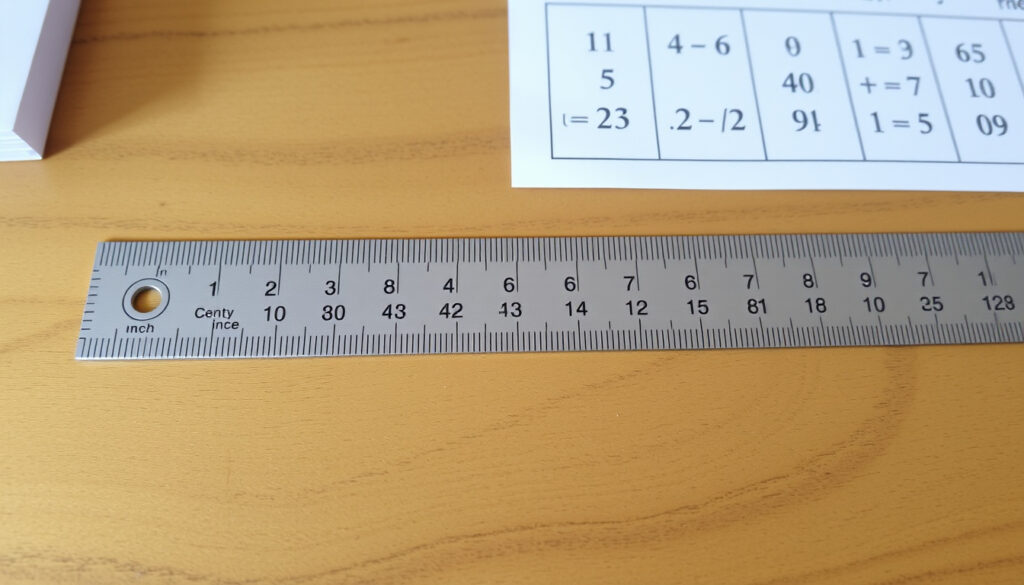
How many mm in an inch on a ruler?
Reading inch and mm markings on a ruler
- A standard ruler has inches on one edge (each inch divided into 16 or 32 marks) and millimeters on the other (each cm = 10 mm).
- Align the object with the zero mark on the inch side, count the smallest divisions. Each 1/16 inch = 1.5875 mm, each 1/32 inch = 0.79375 mm (University of Minnesota table).
- On the mm side, simply read the number directly: 1 inch corresponds to the 25.4 mm mark.
Conversion between scales
- To measure in mm using an inch ruler, multiply the inch measurement by 25.4.
- Online tools and conversion charts from sources like Harvard Medical School streamline the process.
Why this matters: a ruler with both scales is the most tangible reminder that conversion is always a matter of multiplication — not guesswork.
Exact vs Approximate: A Quick Comparison
Three common approximations, one pattern — each falls short by a noticeable margin when precision counts.
| Approximation | Exact value (in inches) | Difference |
|---|---|---|
| 25 mm ≈ 1 inch | 0.984252 | 0.015748 in (0.4 mm) |
| 12 mm ≈ 1/2 inch | 0.472441 | 0.027559 in (0.7 mm) |
| 7 mm ≈ 1/4 inch | 0.275591 | 0.025591 in (0.65 mm) |
The catch: each approximation is off by less than 1 mm, but in precision work that gap is a failure.
Fractional Inch to Millimeter Conversion Table
Ten common fractions, one principle: multiply each decimal equivalent by 25.4 to get exact mm.
| Fraction | Decimal (in) | Exact mm |
|---|---|---|
| 1/32 | 0.03125 | 0.79375 |
| 1/16 | 0.0625 | 1.5875 |
| 1/8 | 0.125 | 3.175 |
| 1/4 | 0.25 | 6.35 |
| 3/8 | 0.375 | 9.525 |
| 1/2 | 0.5 | 12.7 |
| 5/8 | 0.625 | 15.875 |
| 3/4 | 0.75 | 19.05 |
| 7/8 | 0.875 | 22.225 |
| 31/32 | 0.96875 | 24.60625 |
Decimal and mm values verified against the University of Minnesota decimal equivalency table and the Caltrans exact conversion table.
The pattern: each fraction follows the same multiplication by 25.4, ensuring consistency across all measurements.
How to Convert Inches to Millimeters: A Step-by-Step Guide
- Write down the length in inches (e.g., 2.5 inches).
- Multiply by the exact conversion factor: 25.4.
- Result is millimeters. Example: 2.5 × 25.4 = 63.5 mm.
- For fractions, first convert to decimal (e.g., 3/8 = 0.375 in), then multiply.
- Round only if necessary and state the number of significant digits. NIST advises keeping exact values for precision work.
For machinists and engineers, skipping the step of using 25.4 and instead using 25 introduces cumulative error that can break a tolerance stack.
The procedure is straightforward; the key is never to round the conversion factor unless the application tolerates it.
Confirmed Facts and Common Misconceptions
Confirmed facts
- 1 inch = 25.4 mm (international standard since 1959) NIST
- 1/2 inch = 12.7 mm UMN
- 1/4 inch = 6.35 mm UMN
- 25 mm = 0.984252 inches NIST
- All conversions use the same factor: multiply by 25.4
Common misconceptions
- 25 mm = 1 inch (off by 0.4 mm)
- 12 mm = 1/2 inch (off by 0.7 mm)
- 7 mm = 1/4 inch (off by 0.65 mm)
- 1 inch = 2.5 cm (exact is 2.54 cm)
The clarity block shows that the exact values are grounded in international agreement, while the approximations are convenient but inaccurate.
Expert Perspectives on Inch-to-Millimeter Conversion
“The inch is defined as exactly 25.4 mm. This definition was adopted internationally in 1959.”
— National Institute of Standards and Technology (SI conversion factors PDF)
“Table 1 contains exact conversion factors. Use these factors for all design and construction calculations.”
— California Department of Transportation (US Customary Units appendix)
These expert sources reinforce that the 25.4 factor is not negotiable in official standards.
Putting It All Together
The exact conversion from inches to millimeters is one of the few constants in measurement science. For the DIY homeowner estimating lumber, the difference between 25 mm and 1 inch may be trivial. For the aerospace engineer designing a bracket, a 0.4 mm gap is a redesign. The math never changes: multiply by 25.4. The choice to approximate or not is a judgment call based on tolerance, cost, and risk. For anyone relying on metric measurements from imperial specs, the safe rule is simple: never round the conversion factor.
For example, a common fraction like 1/2 inch converts to 12.7 mm, as detailed in this 1/2 inch to mm conversion guide.
Frequently asked questions
What is the history of the inch being defined in metric units?
The inch was redefined as exactly 25.4 mm by the International Yard and Pound Agreement of 1959, signed by the U.S., U.K., Canada, Australia, New Zealand, and South Africa (NIST historical note).
How can I quickly estimate inches to mm without a calculator?
For a rough estimate, multiply inches by 25. For example, 2 inches ≈ 50 mm (exact: 50.8 mm). For 1/2 inch, think 12 mm (but exact is 12.7 mm).
Why is 25 mm used as an approximation for 1 inch in many contexts?
Because 25 is a round number and the error (0.4 mm) is acceptable in many non-precision applications like rough carpentry or general hardware sizing.
How accurate do I need to be when converting inches to mm?
It depends on the application. For structural steel, ±1 mm may be fine; for medical device parts, ±0.01 mm may be required. Always use the exact factor and appropriate significant digits as NIST recommends.
What is the formula to convert mm to inches?
millimeters ÷ 25.4 = inches. Example: 50.8 mm ÷ 25.4 = 2 inches.
How many mm in a cm?
1 cm = 10 mm exactly. 1 inch = 2.54 cm = 25.4 mm (Piedmont Community College reference).
Is 1 inch exactly 2.5 cm?
No. 1 inch = 2.54 cm exactly. The 2.5 cm approximation is 0.04 cm short.
These answers address common points of confusion, helping users apply the exact conversion factor correctly.
More related posts
 Are Bananas Good for Dogs? Benefits, Risks, and Serving Guide
 Baywatch (2017) review: box office flop explained
 How Long to Boil Potatoes for Mashed Potatoes (Perfect)
 Jordan Belfort Net Worth: $200M Peak to $100M Debt
 All in the Family Cast: Who’s Still Alive and Where Now
 Toca Madera Las Vegas: Dress Code, Prices & Menu Guide
 Culver’s Menu with Prices 2024: Full List & Updates
 Pesos Mexicanos a Dólares: Live Exchange Rate & Guide