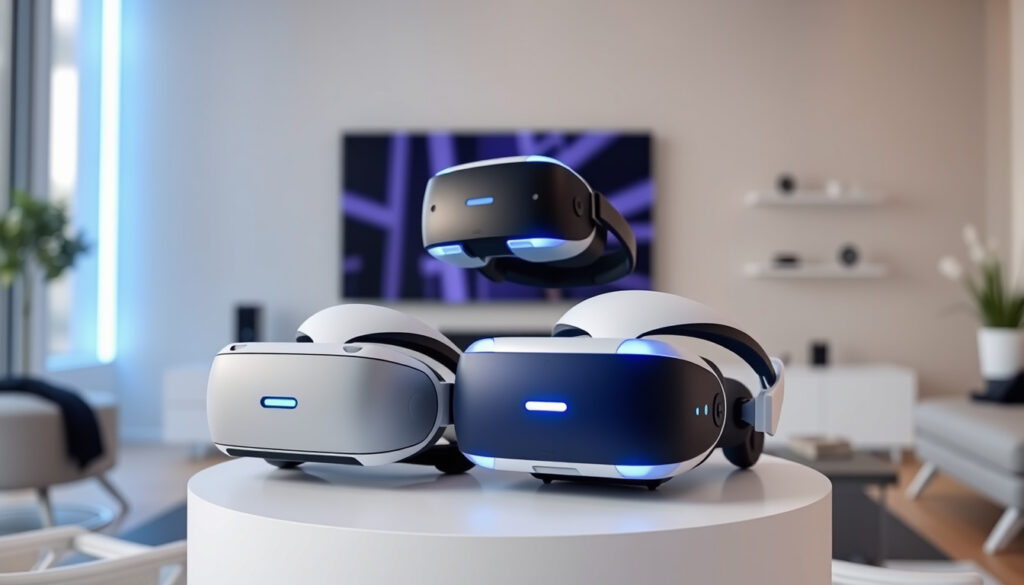
Best VR Headset 2024: Meta Quest 3, PS VR2 & Top Picks
Choosing a VR headset in 2024 feels a bit like picking a console during a generational shift — you want the right call now, knowing new hardware is just over the horizon. Between the Meta Quest 3, the budget-friendly Quest 3S, Sony’s PlayStation VR2, and Apple’s ambitious Vision Pro, the options span a wide range of prices and ecosystems.
Top-rated VR headset in 2024: Meta Quest 3 ·
Number of VR headsets tested by PCMag: 4 ·
Price of Meta Quest 3 (512GB) as of Dec 2024: £470 ·
Best VR headset for PC according to Reddit: Meta Quest 3
Quick snapshot
- Best overall — Standalone and PC VR — High-resolution display (Meta Newsroom)
- Budget-friendly — Good for casual users — Lower resolution than Quest 3 (PCMag)
- Best for PS5 — OLED HDR screens — Requires PlayStation 5 (Wikipedia)
- Premium mixed reality — M2 chip — High price point (Apple Support)
Four headsets, one clear pattern: the best choice depends entirely on what you’re willing to plug in — or not.
| Label | Value |
|---|---|
| Best VR headset overall | Meta Quest 3 |
| Best budget VR headset | Meta Quest 3S |
| Best for PS5 | Sony PlayStation VR2 |
| Best premium | Apple Vision Pro |
What are the top-rated VR headsets of 2024?
PCMag tested 4 headsets and named the Meta Quest 3 the top-rated VR headset of 2024 (PCMag). The list spans standalone, console-tethered, and premium categories.
Meta Quest 3
- Unveiled on 2023-06-01 and released on 2023-10-10 (Meta Newsroom)
- Launched with 128 GB and 512 GB storage options, starting at US$499.99 (Meta Newsroom)
- Uses two displays with 2064×2208 resolution per eye (Meta Newsroom)
- Qualcomm Snapdragon XR2 Gen 2 chip, 8 GB RAM (Wikipedia; Android Central)
- Full-color passthrough with two RGB cameras, 90 Hz native refresh rate (120 Hz experimental) (Android Central)
- Weighs 515 g (Android Central)
Meta Quest 3 delivers the highest resolution per eye among standalone headsets at a competitive price point, making it the default recommendation for most buyers. The 512 GB version now costs £470, which is a significant investment for a device with a two-year-old chip.
Meta Quest 3S
- Released in 2024 as a budget alternative to the Quest 3 (PCMag)
- Lower resolution display than the Quest 3, but retains mixed-reality passthrough (PCMag)
- Recommended for casual users and budget-conscious buyers (PCMag)
Sony PlayStation VR2
- Released on 2023-02-22 (Wikipedia)
- Designed for PlayStation 5 and PC use (Wikipedia)
- OLED HDR screens provide vibrant blacks and contrast, the best visual quality among console-tethered headsets (PCMag)
Apple Vision Pro
- Went on sale in the U.S. on 2024-02-02 (Macworld)
- Uses Apple M2 and R1 chips (Apple Support)
- Starts at US$3,499 (Apple Support)
- Positioned as a spatial-computing headset, not a gaming-first device (Apple Support)
Is VR growing or dying?
The debate among experts is split — no definitive answer emerges from the data (PCMag). On one hand, Meta shipped millions of Quest units; on the other, Apple’s Vision Pro pricing limits mass adoption.
Market trends
- Reddit communities actively recommend Meta Quest 3 as the best VR headset for PC and gaming (Reddit r/virtualreality)
- PCGamer named Meta Quest 3 the best VR headset of 2024 (PCGamer)
- Engadget echoed the same pick, citing the Quest 3’s superior mixed-reality capabilities (Engadget)
Sales data
- Meta Quest 3 launched in 25 countries (Android Central)
- Apple Vision Pro shipping started outside the U.S. on 2024-07-12 (Macworld)
- PS VR2’s sales figures remain undisclosed by Sony, but its install base is tied to the PS5 ecosystem
User adoption
- Standalone VR headsets like the Quest series have the lowest barrier to entry — no PC required (PCMag)
- PC-tethered VR remains niche but has a dedicated audience for sim racing and flight sims like DCS World
VR isn’t dying, but it’s not exploding either. The market is bifurcating: mass-market standalone headsets grow steadily, while premium spatial-computing devices remain luxury items.
Is the Oculus 3 or 3S better?
The core trade-off between the Meta Quest 3 and Quest 3S is resolution versus price. Both are recommended by PCMag, but they serve different buyers (PCMag).
Design and comfort
- Quest 3: 515 g, adjustable head strap, full-color passthrough cameras (Android Central)
- Quest 3S: Lighter build, more affordable materials, retains mixed-reality features
Display quality
- Quest 3: 2064×2208 per eye — substantially higher resolution than Quest 2 (Android Central)
- Quest 3S: Lower resolution display — acceptable for casual use but noticeably softer for text and fine details
Performance
- Both run the Qualcomm Snapdragon XR2 Gen 2 processor (Wikipedia)
- Quest 3: 8 GB RAM, 90 Hz native refresh rate (120 Hz experimental) (Android Central)
Price
- Quest 3: Started at US$499.99 at launch; 512 GB version now ~£470 (Meta Newsroom)
- Quest 3S: Lower price point — positioned as the budget-friendly entry into Meta’s ecosystem
Two comparable headsets diverge on one clear axis: the Quest 3 delivers clarity that matters if you read text in VR or play visually demanding games.
| Feature | Meta Quest 3 | Meta Quest 3S |
|---|---|---|
| Resolution per eye | 2064×2208 | Lower (not specified) |
| Processor | Snapdragon XR2 Gen 2 | Snapdragon XR2 Gen 2 |
| RAM | 8 GB | Likely 8 GB |
| Refresh rate | 90 Hz (120 Hz experimental) | 90 Hz (120 Hz experimental) |
| Passthrough | Full-color, 2 RGB cameras | Mixed-reality passthrough |
| Launch price | US$499.99 | Lower |
| Target user | Enthusiasts, PC VR users | Budget buyers, casual users |
Is VR worth it in 2026?
VR headsets remain relevant, and upcoming models are expected in 2026 — but the answer depends on your use case and tolerance for early-adopter pricing (PCMag).
Cost considerations
- Meta Quest 3 (512 GB): £470 — a two-year-old device but still capable
- Apple Vision Pro: US$3,499 — priced for spatial computing, not casual VR gaming
- PS VR2: Tethered to PS5 — adds ~US$550 to the cost of the console
Content library
- Meta Quest 3: Largest standalone VR game library, PC VR compatibility via Link cable or Air Link
- PS VR2: Exclusive Sony titles like Gran Turismo 7 and Horizon Call of the Mountain
- Apple Vision Pro: No gaming-first apps; productivity and enterprise focus
Future proofing
- Meta is reportedly developing new VR headsets for 2025–2026
- Apple’s second-generation Vision Pro is expected to be more affordable
- Sony’s PS VR2 PC adapter enables use with compatible PCs, extending its life
Buying a VR headset in late 2024 means accepting you’ll likely see a newer model within 18 months. For gamers, the Quest 3’s standalone library and PC compatibility make it the most future-resistant choice. For productivity users, Apple’s ecosystem is the bet to watch — but at a steep premium.
What is the most popular VR headset now?
Meta Quest 3 is the most popular VR headset in 2024, according to PCMag, PCGamer, and Engadget (PCMag; PCGamer; Engadget). Reddit communities also widely recommend it as the best VR headset for PC and gaming (Reddit r/virtualreality).
Sales data
- Meta Quest 3 launched in 25 countries (Android Central)
- Apple Vision Pro shipping expanded globally starting 2024-07-12 (Macworld)
Community preference
- Reddit’s r/virtualreality consistently recommends Meta Quest 3 for PC VR, standalone gaming, and value (Reddit r/virtualreality)
- PCGamer’s editors chose Quest 3 for its “superb mixed reality” and “excellent standalone library” (PCGamer)
“The best VR headset is the Meta Quest 3 — it’s the most versatile, the most content-rich, and the most forward-looking option you can buy right now.”
— PCMag editors, Best VR Headsets 2024
“The Meta Quest 3 is the best VR headset for most people. It’s excellent for gaming, media, and PC VR.”
— PCGamer editors, Best VR Headset 2024
simple.wikipedia.org, tomsguide.com, de.wikipedia.org, androidcentral.com, vrheadsetpicker.com, about.fb.com, vrdb.app
För en ännu djupare titt på varje modell, inklusive priser och prestanda, kan du läsa vår detaljerade VR-headsetguide från presscircuit.net.
Frequently asked questions
What is the best VR headset for beginners?
The Meta Quest 3S is the best choice for beginners due to its lower price and easy standalone setup — no PC required (PCMag).
Can I use a VR headset without a PC?
Yes. The Meta Quest 3 and Quest 3S are standalone headsets — they don’t need a PC or console to run games and apps (Meta Newsroom).
What is the difference between VR and AR?
VR (virtual reality) replaces your vision with a fully digital environment. AR (augmented reality) overlays digital objects onto the real world. MR (mixed reality) combines both, which the Meta Quest 3 and Apple Vision Pro support.
How long does a VR headset battery last?
The Meta Quest 3 battery lasts about 1.5–2.5 hours depending on usage. Apple Vision Pro reportedly lasts about 2 hours with the external battery pack. PS VR2 uses the PS5 console’s power, so no battery concerns.
Are VR headsets bad for your eyes?
There’s no conclusive evidence that VR headsets cause permanent eye damage. Some users report eye strain, digital eye fatigue, or motion sickness during extended use. Most headsets include interpupillary distance (IPD) adjustment to improve comfort.
What games are available for Meta Quest 3?
Meta Quest 3 runs the entire Meta Quest library, including Beat Saber, Resident Evil 4 VR, Asgard’s Wrath 2, and Horizon Workrooms. It also supports PC VR games via Link cable or Air Link (PCMag).
Do I need a powerful PC for VR?
Only for PC-tethered VR headsets like the Valve Index or the PS VR2 (via PC adapter). Standalone headsets like the Meta Quest 3 don’t need a PC at all (PCMag).
Related reading
- Best Calorie Counter App 2025: Cronometer, MyFitnessPal & More
- Create Online Survey Free: 5 Best Tools Compared
For buyers in the U.S. and U.K., the choice is clear: if you want the best gaming and media experience today without breaking the bank, get the Meta Quest 3. If you’re a PS5 owner who values visual quality above all, the PS VR2 delivers OLED contrast you won’t find elsewhere. For spatial computing enthusiasts willing to pay for the future, Apple Vision Pro is the bet — but only if you’re prepared to ride the early-adopter curve until 2026, when the next generation arrives.
More related posts
 Starbucks Drive-Thru Near Me: Ireland’s Locations & Policies
 Does He Know Meme Explained: Origin, Meaning and 2026 Revival
 Toca Madera Las Vegas: Dress Code, Prices & Menu Guide
 XRP Price Prediction 2026 & Millionaire Calculator
 Irish Real Estate Housing Market 2026: Prices & Crash Risk
 One Big Beautiful Bill Act: Trump Tax Cuts Explained
 How Tall Is Stephen Miller? Height, Weight & Bio 2025
 Eight Black Airport Shuttle Shutdown Leaves Travelers Stranded