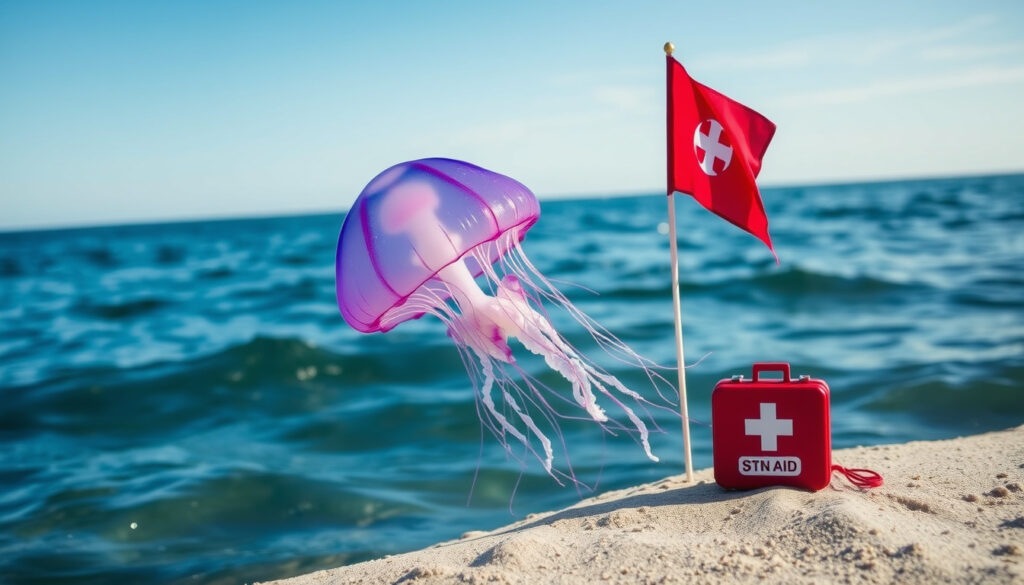
Man O’ War Jellyfish: Venom, Sting Treatment & Differences
You’ve probably seen the photos: a translucent blue bubble floating on the water, trailing ribbon-like tentacles that can stretch longer than a blue whale. But what looks like a jellyfish is actually something far stranger — a floating colony of specialized animals working together as one.
Largest recorded float size: 12 inches (30 cm) ·
Tentacle length (maximum recorded): 165 feet (50 m) ·
Number of species in genus Physalia: 2 (P. physalis, P. utriculus) ·
Estimated fatal stings per year worldwide: Less than 1% of total stings (rare) ·
True jellyfish? No, it is a: colonial siphonophore
Quick snapshot
- Portuguese man o’ war is a colonial siphonophore, not a jellyfish (NOAA Ocean Service, U.S. government agency)
- Hot water soak (113–122°F) is recommended first aid for tentacle stings (WebMD health information)
- Box jellyfish (Chironex fleckeri) is considered the most venomous marine animal (MSD Manuals medical reference)
- Exact number of fatal man o’ war stings per year is not tracked globally (Columbia Doctors academic medical center)
- Long-term survival of individual zooids under extreme environmental stress is not fully known (Wildlife Trusts UK conservation charity)
- Man o’ war colonies drift with ocean currents — their movement is unpredictable (NOAA Ocean Service)
- Peak stranding events in Europe often occur in late summer and autumn (Wildlife Trusts)
- Climate change may expand their range northward into cooler waters (Environmental Literacy Council)
- Better public education on first aid can reduce hospital visits from stings (Cleveland Clinic medical institution)
| Field | Value |
|---|---|
| Scientific name | Physalia physalis (Atlantic species) |
| Also known as | Portuguese man o’ war |
| Classification | Siphonophore (Hydrozoa) |
| Average float size | 6–12 inches (15–30 cm) |
| Maximum tentacle length | 165 feet (50 meters) |
| Sting lethality | Rarely fatal — < 0.1% of reported stings |
What’s the difference between jellyfish and man o’ war?
Why the Portuguese man o’ war is a siphonophore
- The Portuguese man o’ war is a colonial hydrozoan (siphonophore), not a true jellyfish (NOAA Ocean Service)
- Each colony consists of specialized zooids: pneumatophore (float), gastrozooids (feeding), and dactylozooids (defense) (Wildlife Trusts)
- True jellyfish are individual medusae in class Scyphozoa (Wikipedia)
Think of the man o’ war as a tiny floating city, where each citizen has a single job — one floats, another eats, another stings. A true jellyfish, by contrast, is a single organism that does everything itself.
Colonial life means the man o’ war can never swim or hunt on its own — it’s completely at the mercy of wind and currents. But that drift-and-sting strategy has worked for millions of years.
How colonial organization differs from a single jellyfish body
- A true jellyfish has one mouth, one nerve net, and one set of tentacles attached to a bell (Cleveland Clinic)
- In a man o’ war colony, each zooid is genetically identical but morphologically distinct — some are specialized for digestion, others for reproduction (Wildlife Trusts)
- The gas-filled float (pneumatophore) can be deflated to submerge briefly, but the colony cannot actively propel itself (NOAA Ocean Service)
The implication: when you’re stung by a man o’ war, you’re actually being stung by dozens of tiny dactylozooids firing in unison — not one large jellyfish tentacle.
How poisonous is the man-o-war jellyfish?
Venom composition and delivery mechanism
- Venom contains potent toxins including physalitoxin, a protein that disrupts cell membranes (MSD Manuals)
- Tentacle contact triggers nematocyst discharge — harpoon-like structures inject venom into the skin (Cleveland Clinic)
- Each tentacle can contain thousands of nematocysts along its length (WebMD)
Even a dead man o’ war washed up on the beach can still sting — nematocysts remain active for weeks after the colony dies. Touching the float alone is no guarantee of safety.
Severity scale of man o’ war stings
- Sting causes severe pain, red welts, and localized swelling — but death is extremely rare (Columbia Doctors)
- Systemic symptoms can include nausea, vomiting, muscle cramps, and headache (MSD Manuals)
- Less than 1% of reported stings result in hospitalization (Cleveland Clinic)
The pattern: the man o’ war is a “high pain, low death” creature — its venom is designed to paralyze small fish, not kill humans.
What happens if you get stung by Man O’ War?
Immediate symptoms after tentacle contact
- Intense, shooting pain that can radiate up the limb — often described as being whipped by an electric cord (WebMD)
- Red, whip-like welts that may blister within hours (Cleveland Clinic)
- Nausea, muscle cramps, and in rare cases difficulty breathing (MedlinePlus, U.S. National Library of Medicine)
First aid steps for Portuguese man o’ war sting
- Rinse the area with seawater — do not use fresh water, which can cause more nematocysts to discharge (Cleveland Clinic)
- Remove visible tentacles with tweezers or gloved hands — never rub with bare hands (MSD Manuals)
- Immerse the stung area in hot water at 104–113°F (40–45°C) for 20–45 minutes (WebMD)
- Do not use vinegar — unlike for box jellyfish, vinegar can trigger additional venom release from unfired nematocysts (MSD Manuals)
- Apply hydrocortisone cream or calamine lotion to reduce itching and pain after initial treatment (Cleveland Clinic)
“Hot water immersion is the most effective way to inactivate the venom proteins. The temperature should be as hot as the rescuer can comfortably tolerate — about 113°F.”
— ANZCOR Guideline 9.4.5: Envenomation – Jellyfish Stings (Australian Resuscitation Council)
When to seek medical attention
- Difficulty breathing, chest pain, or swelling of the tongue or throat — call emergency services immediately (MedlinePlus)
- Pain that worsens or does not improve after treating with hot water (Columbia Doctors)
- Development of a deep sore or ulcer at the sting site, which may require wound care to prevent infection (Columbia Doctors)
Vinegar is a lifesaver for box jellyfish stings, but it can make a man o’ war sting far worse. If you’re unsure which creature stung you, skip the vinegar and go straight to hot water.
Which is deadlier, box jellyfish or man o war?
Box jellyfish venom potency vs. man o war
- Box jellyfish (Chironex fleckeri) venom can cause cardiac arrest within minutes of contact (MSD Manuals)
- Man o’ war venom is potent but rarely induces life-threatening systemic effects (Cleveland Clinic)
- The box jellyfish has a more complex venom cocktail that targets the heart and nervous system directly (Wikipedia)
Six key differences show one pattern: box jellyfish is designed for rapid kill, man o’ war for persistent defense.
| Feature | Box jellyfish | Portuguese man o’ war |
|---|---|---|
| Classification | True jellyfish (Cubozoa) | Colonial siphonophore (Hydrozoa) |
| Venom target | Heart and nervous system | Local cell membranes (pain-dominant) |
| Time to death (if untreated) | 2–5 minutes | Hours to days (rare) |
| Number of fatal stings per year (global estimate) | ~40–100 | <10 |
| First aid priority | Vinegar (inactivates nematocysts) | Hot water (denatures venom) |
| Antivenom available | Yes (Australia) | No standard antivenom |
The implication: a box jellyfish sting is a medical emergency with a ticking clock; a man o’ war sting is agonizing but rarely fatal with proper care.
What is the deadliest jellyfish alive?
Top 5 deadliest jellyfish species
- Box jellyfish (Chironex fleckeri) — considered the most venomous marine animal (MSD Manuals)
- Irukandji jellyfish (Carukia barnesi) — causes severe delayed symptoms including hypertension and cardiac complications (Wikipedia)
- Portuguese man o’ war — ranks lower in lethality, but high in painful encounters (Cleveland Clinic)
- Sea nettle (Chrysaora) — common stinger, rarely fatal (WebMD)
- Lion’s mane jellyfish (Cyanea capillata) — large tentacles, painful but not typically deadly (Wildlife Trusts)
The implication: the man o’ war is not the deadliest, but it’s one of the most commonly encountered — and the one most likely to send a beachgoer to the ER for pain relief.
Can a Portuguese man of war kill you?
Conditions under which man o’ war stings become fatal
- Death is very rare — mostly from anaphylactic shock or drowning after pain-induced panic (MSD Manuals)
- Children and elderly are at higher risk due to lower body mass and potential for allergic reactions (Cleveland Clinic)
- Treatment with antivenom is not standard — no specific antivenom exists for Physalia venom (Columbia Doctors)
Risk factors for allergic reactions
- Previous allergic reactions to jellyfish or insect stings increase risk of anaphylaxis (ANZCOR)
- Multiple stings (e.g., swimming through a large colony) can deliver enough venom to overwhelm the body (WebMD)
- Delayed hypersensitivity may cause skin ulceration that requires medical follow-up (Columbia Doctors)
For a healthy adult, the man o’ war is more of a vicious cautionary tale than a lethal threat. But for a child, an elderly person, or someone with allergies, a sting can turn serious fast.
Man o’ war jellyfish size and distribution
How large can the float and tentacles grow
- Float up to 12 inches (30 cm) across — the gas-filled bladder acts as a sail (NOAA Ocean Service)
- Tentacles can stretch 165 feet (50 meters) — longer than a blue whale (Wikipedia)
- The tentacles are not a single structure but a bundle of dactylozooids, each capable of independent movement (Wildlife Trusts)
Where to find Portuguese man o’ war (including Ireland)
- Found in tropical and subtropical Atlantic, Gulf of Mexico, and the Caribbean (NOAA Ocean Service)
- Sometimes washed up on European coasts, including Ireland, where they are carried by the Gulf Stream (Wildlife Trusts)
- Ocean currents and wind drive their movement — they cannot swim, so they aggregate in windward areas (Wikipedia)
For beachgoers in Ireland, Florida, or the UK, the risk is highest after prolonged onshore winds. Check local beach warnings before swimming.
“The Portuguese man o’ war, (Physalia physalis) is often called a jellyfish, but is actually a species of siphonophore.”
— NOAA Ocean Service (National Oceanic and Atmospheric Administration)
“First of all, the Portuguese Man O’War is not a jellyfish. It is a colonial hydrozoan, made up of small individual animals called zooids.”
— Wildlife Trusts (UK conservation charity)
For Florida visitors, the likelihood of encountering man o’ war on beaches is high — be prepared with the correct first aid and know where to seek help (Best Beaches in Florida). And if you’re dealing with any kind of acute pain, general first aid principles apply — see How to Relieve Upper Stomach Pain Immediately: 5 Fast Remedies for immediate relief strategies.
Frequently asked questions
Is the Portuguese man o’ war immortal like the immortal jellyfish?
No. The immortal jellyfish (Turritopsis dohrnii) can revert to its polyp stage, effectively cheating death. The Portuguese man o’ war has no such ability — colonies die when they strand, or when their zooids age and fail.
How long do man o’ war tentacles stay venomous after beaching?
Nematocysts can remain active for weeks or even months after the colony dies. Even a dried, dead-looking man o’ war on the sand can still deliver a painful sting.
Can you touch the float of a man o’ war without getting stung?
Not safely. The float is covered in small nematocysts, and tentacles can wrap around from underneath. The safest rule: never touch any part of a man o’ war, alive or dead.
What should you do if a dog is stung by a man o’ war?
Rinse the area with seawater, remove any tentacles with tweezers, and apply hot water compresses. Take the dog to a veterinarian immediately — dogs can have severe allergic reactions. Do not use vinegar.
Are there man o’ war jellyfish in the Mediterranean Sea?
Yes, the Atlantic species Physalia physalis occasionally enters the Mediterranean through the Strait of Gibraltar. A separate species, Physalia utriculus, is found in the Indo-Pacific and is smaller.
More related posts
 Cast of Predator: Badlands (2025) – Full Cast and Character Guide
 Sabrina Carpenter Barry Keoghan – Timeline from Fashion Week to Split
 In-N-Out Menu: Prices, Secret Items, and Dublin Pop-Up (2026)
 Toy Story 4 Cast: Full Voice Actors & Characters List
 Culver’s Menu with Prices 2024: Full List & Updates
 Crawl Space Repair Near Me: Costs, Mold Risks & Fixes
 How Long Do Butterflies Live? Average Lifespan Guide
 Soft Autumn Color Palette: Colors to Wear and Avoid