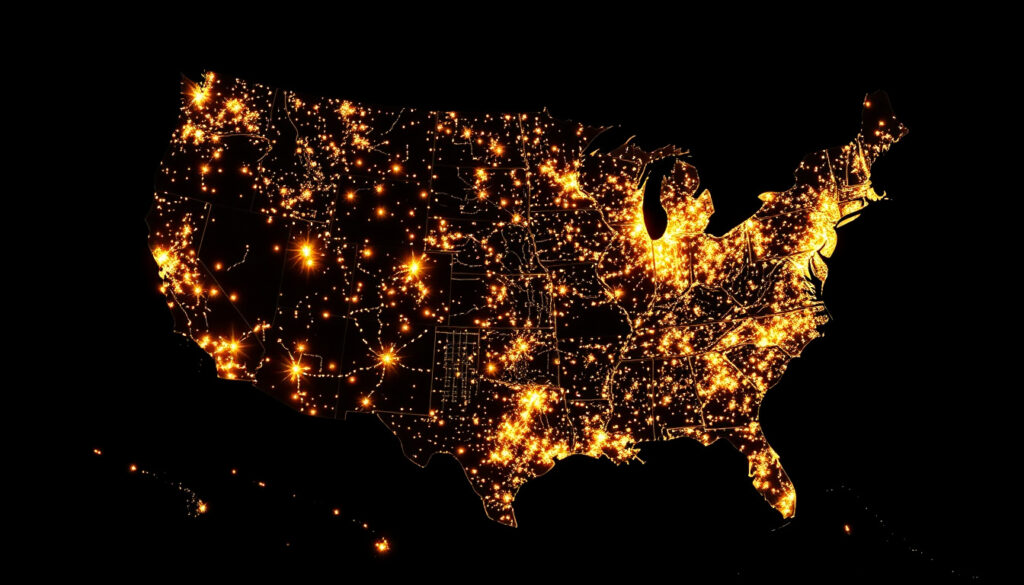
What Is the Population of the United States? 2025 Data & Breakdown
The U.S. Census Bureau puts the nation’s population at 341,784,857 as of July 2025, making it the third-most populous country on Earth. If you’ve ever wondered how that number breaks down by race, age, or geography — and what those patterns mean for policy and markets — the data tells a clear story.
Current U.S. Population: 348,817,083 (2026 projection) · 2025 Estimate: 341,784,857 · 2024 Population: 340,110,988 · Annual Growth: 0.5% to 0.52% · World Rank: 3rd largest
Quick snapshot
- The U.S. counted 341,784,857 residents on July 1, 2025 (Census Bureau)
- The nation ranks third globally, behind India and China (USAFacts)
- Growth has held steady at roughly 0.5% annually in recent years (Census Bureau)
- Exact 2026 breakdowns by race remain pending Census Vintage 2026 release (Census Bureau estimates)
- State-level race figures for 2024-2025 are partially estimated rather than fully enumerated (Census Bureau estimates)
- The Census Bureau’s Vintage 2025 state-by-race tables are now available for 2020–2025 (Census state estimates)
- Multiracial and Hispanic shares are projected to keep climbing in coming decades (USAFacts demographic analysis)
| Metric | Value | Source |
|---|---|---|
| Total Population (2026 projection) | 348,817,083 | Census Bureau |
| 2025 Census Estimate | 341,784,857 | Census QuickFacts |
| 2024 Census Estimate | 340,110,988 | Census QuickFacts |
| World Population Rank | 3rd | USAFacts |
| Annual Growth Rate | 0.52% | Census Bureau |
| White non-Hispanic Share (2024) | 57% | USAFacts |
| Black Population (2023) | 48,300,000 | Pew Research |
| Multiracial Population (2022) | 8,400,000 | USAFacts |
What are the 10 countries with the largest population?
The United States holds the third spot on the global population rankings, but the gap between it and the two countries ahead is substantial. India leads with roughly 1.45 billion people as of 2025, followed by China at approximately 1.42 billion. The U.S. sits at 341.8 million — less than a quarter of India’s total.
Eight other nations round out the top 10, with Indonesia, Pakistan, Nigeria, Brazil, Bangladesh, Russia, Mexico, and Ethiopia filling positions four through ten. Each of these countries presents distinct demographic pressures, from Nigeria’s rapid growth rate to Japan’s contracting population.
Top 10 by UN estimates
The table below shows the world’s most populous nations alongside key notes about each country’s demographic trajectory.
| Rank | Country | Approximate Population | Notes |
|---|---|---|---|
| 1 | India | 1.45 billion | Surpassed China in 2023 |
| 2 | China | 1.42 billion | Facing population decline |
| 3 | United States | 341.8 million | Third globally |
| 4 | Indonesia | 280 million | Largest in Southeast Asia |
| 5 | Pakistan | 251 million | High fertility rate |
| 6 | Nigeria | 230 million | Fastest growth in top 10 |
| 7 | Brazil | 220 million | Stable growth |
| 8 | Bangladesh | 176 million | Densely populated |
| 9 | Russia | 144 million | Declining population |
| 10 | Mexico | 130 million | Steady growth |
Demographic analysts at the Census Bureau project the U.S. will remain in third place through at least 2050. Even with its 0.52% annual growth rate, the population gains are modest compared with faster-expanding nations like Nigeria or Pakistan.
What is the population of the United States by race?
The U.S. population by race has shifted considerably over the past three decades. According to Census Bureau data, non-Hispanic white residents made up 57% of the population in 2024 — down from 76% in 1990 and 69% in 2000. This long-term trend reflects immigration patterns, higher birth rates among non-white populations, and increasing numbers of Americans who identify as multiracial.
White percentage
When counting only non-Hispanic white residents, the 2024 figure stands at 57%, per USAFacts (USAFacts: America in Facts 2025). This is notably lower than the 71% share recorded when including white Americans who also identify with other races. The distinction matters: “white alone” and “white non-Hispanic” track different populations, and sources sometimes cite one or the other without clarification.
Fastest growing race
The multiracial category is the fastest-growing racial group in the country. The multiracial population grew from 3.5 million in 2000 to 8.4 million in 2022, representing a 145% increase (USAFacts). This reflects both changes in how the Census Bureau allows residents to identify and genuine demographic growth as mixed-race families become more common.
According to Pew Research, the Black population stood at 48.3 million in 2023 — roughly 14.4% of the U.S. total — representing a 33% increase since 2010 (Pew Research Center). Hispanic or Latino residents number approximately 62 million, or about 19% of the population, per Wikipedia citing Census data (Wikipedia: U.S. States by Race/Ethnicity).
The implication: the country has crossed a threshold where no single racial group constitutes a majority of the population when using the non-Hispanic white definition. Children under 18 are already majority-minority — roughly 50% of under-18s were ethnic minorities as of the 2020 Census.
What percentage of the U.S. is white?
The answer depends on how you define “white.” Under the Census Bureau’s definition of non-Hispanic white alone, white residents accounted for 57% of the U.S. population in 2024 (USAFacts). Including white residents who also identify with other racial categories pushes that figure to roughly 71% of the population. Both figures are cited in different contexts, which is why the percentage can appear to range from 57% to 71% depending on the source.
State variations
White population percentages vary dramatically by state. California has among the lowest non-Hispanic white shares at roughly 34.69%, while states like Maine, Vermont, and West Virginia exceed 94% (Wikipedia). Louisiana has the highest non-Hispanic Black share at 31.18%, while Alaska has the highest Native American/Alaska Native share at 14.84%.
Massachusetts presents an interesting case: its non-Hispanic white population sits at 67.55%, yet it also has one of the highest Asian shares at 7.18% — well above the national average. This reflects the state’s large immigrant communities and educational institutions that attract Asian residents from across the globe.
What this means: regional diversity patterns mean national averages can be deeply misleading when planning for local markets, schools, or public services. A business or government agency operating nationally needs to account for a 60-percentage-point gap between the whitest and least-white states.
What is the whitest U.S. state?
Maine holds the distinction of being the whitest U.S. state by non-Hispanic white population percentage, with figures consistently above 94% in recent Census estimates. Vermont and West Virginia follow closely. These states have relatively low immigration rates and have experienced minimal internal migration from more diverse regions.
States with smallest Black population
States with the smallest Black populations tend to be those with the smallest overall populations or those in the Mountain West and Upper Plains. Montana, Wyoming, and Idaho report Black populations below 1% of their total residents. This is partly a function of historical settlement patterns and partly a reflection of ongoing economic migration that pulls Black residents toward larger metropolitan areas in the South, Northeast, and West Coast.
Louisiana, by contrast, has the highest non-Hispanic Black population share among states at 31.18% (Wikipedia). Alabama, Mississippi, and Georgia also maintain Black population shares above 25%. The regional concentration has implications for political representation, cultural institutions, and public health resource allocation.
The catch: raw percentages can obscure population counts. Montana may be 97% white, but its total population of roughly 1.1 million means even a small Black population in absolute terms represents tens of thousands of residents with distinct needs and community structures.
What is the fastest growing race in the United States?
The multiracial population is the fastest-growing racial category in the United States. As noted, the number of Americans identifying as multiracial grew from 3.5 million in 2000 to 8.4 million in 2022, a 145% increase (USAFacts). This growth outpaces every other racial or ethnic group by a wide margin.
By age and demographics
The multiracial population skews heavily young. Census analysis shows multiracial children and teenagers are far more common than multiracial seniors, reflecting both demographic change and increasing social acceptance of mixed-race identity. Among younger cohorts, multiracial identification is growing as parents raise children who feel comfortable claiming multiple heritages.
Hispanic or Latino residents also grow faster than the overall population, though at a more moderate rate. The Hispanic population has expanded from roughly 50 million in 2000 to over 62 million today, driven by both immigration and higher birth rates among native-born Hispanic families.
Why this matters: the fastest-growing populations are also the youngest. That means schools, youth sports leagues, and social services designed around a historically white-dominated demographic may need to adapt to serve increasingly diverse communities. The political implications of demographic shifts will play out over the next two decades as these younger cohorts reach voting age.
Related reading: Social Security Administration Identity Proofing Requirements Guide · How to Apply for Food Stamps: USA SNAP & Ireland Guide
neilsberg.com, wonder.cdc.gov, worldpopulationreview.com, en.wikipedia.org, tamus.edu, census.gov
Census Bureau estimates peg the US population at 341.8 million as of July 2025, with detailed breakdowns sourced from the United States Bureau of the Census.
Frequently asked questions
What is the population of the world?
As of 2025, the global population stands at approximately 8.1 billion, per United Nations estimates. India and China together account for roughly 2.9 billion of those residents.
What is the population of the United States 2020?
The 2020 Census recorded 331,449,281 residents across the 50 states and the District of Columbia. This figure was the official decennial census count used for congressional apportionment.
How many adults are in the United States?
According to Census Bureau estimates, adults aged 18 and over constitute roughly 78% of the population, meaning approximately 266 million adults lived in the U.S. as of 2025.
What is the biggest nationality in America?
The largest ethnic group by ancestry in the U.S. is German, followed by Mexican, Irish, and English. However, these figures are based on self-reported ancestry surveys and overlap significantly — many Americans claim multiple ancestries.
What is the richest country?
By nominal GDP, the United States is the world’s wealthiest country, producing roughly $26 trillion in annual output as of 2024. By GDP per capita, however, nations like Luxembourg, Switzerland, and Ireland outrank the U.S.
What is the whitest country in the world?
Countries with the highest proportion of white or European-descended populations include Iceland (over 95%), Finland, and Norway — though “whiteness” as a legal or demographic category varies widely by country and is not consistently defined internationally.
What experts and data organizations say
In 2024, white, non-Hispanic people were 57% of the US population — down from 76% in 1990 and 69% in 2000.
— USAFacts (America in Facts 2025)
The multiracial population grew faster than any other demographic, from 3.5 million people to 8.4 million people, a 145% increase.
— USAFacts (America in Facts 2025)
In 2023, an estimated 48.3 million people self-identified as Black, making up 14.4% of the country’s population.
— Pew Research Center (Facts About the U.S. Black Population)
For those tracking American demographics, the direction is clear: the nation is becoming more diverse, more multiracial, and less dominated by any single racial group. Governments and businesses that plan around a static demographic picture will find themselves out of step with the electorate and the consumer base.
More related posts
 What Is a Life Coach: Role, Cost, Salary & Qualifications
 Dancing with the Stars Streaming: Where to Watch Every Season
 Taylor Swift: The Eras Tour – Record Revenue and Bonuses
 Alaska PFD Stimulus September 2025: Eligibility & Payment Dates
 The Sisterhood of the Traveling Pants: Full Guide
 Type A vs Type B: Personality Traits, Differences & Quiz
 Friday the 13th (2009): Reboot, Cast, Ending Guide
 How Long Do Butterflies Live? Average Lifespan Guide