Coffee Places Near Me: Irish Coffee Spots, Cafés & Tips
Anyone who’s ever typed “coffee places near me” into their phone knows the feeling: you want something good, close by, and maybe a little local. In Ireland that search is more rewarding than ever, with over 3,000 coffee shops nationwide serving everything from a quick espresso to a proper Irish coffee — and this guide cuts through the listings to show what makes a café different from a coffee shop, where to find the best brews in Dublin, Cork, Limerick, and Tipperary, and why your morning coffee timing matters.
Oldest coffee house in the world: Café Procope, founded in 1686 in Paris · Irish coffee invention year: 1943 at Foynes airbase, Ireland · Number of coffee shops in Ireland (approx.): Over 3,000
Quick snapshot
- Irish coffee was invented at Foynes airbase in 1943 (Foynes Flying Boat Museum (primary source))
- Café Procope in Paris, opened in 1686, is the oldest operating coffee house (Café Procope (historical record))
- The exact definition of “café” vs “coffee shop” varies by region and culture (Merriam-Webster (language dictionary))
- Which coffee is “most tastiest” is subjective and not universally agreed upon (Merriam-Webster (language dictionary))
- Copper + Straw in Dublin holds a 4.9/5 rating from 198 Tripadvisor reviews — user-generated data, not a definitive ranking (Tripadvisor (user review aggregator))
- 1943: Irish coffee invented at Foynes airbase (Foynes Flying Boat Museum (primary source))
- 2012: Filter opens first specialty coffee shop in Cork (Sprudge (specialty coffee media))
- Ireland’s coffee culture shows continued upsurge in artisan producers like Ponaire Coffee in Limerick (Good Food Ireland (food tourism authority))
- Indy Coffee Guide No3 handpicks over 100 specialty coffee shops and roasteries across Ireland (Indy Coffee Guide (specialty coffee directory))
Six key data points that any coffee explorer in Ireland should know, one pattern: many of the best numbers come from independent sources rather than chains.
| Label | Value |
|---|---|
| Oldest coffee house | Café Procope (1686) Café Procope (historical record) |
| Irish coffee origin | Foynes, 1943 |
| Starbucks founding year | 1971 Starbucks (corporate history) |
| Top-rated cafe Dublin | Copper + Straw, 4.9/5 (198 reviews) |
| Specialty shops in Ireland (Indy Guide No3) | Over 100 |
| First Filter cafe opened | 2012 in Cork |
What are the top 5 popular coffees?
Whether you’re ordering at a counter or browsing a menu board, these five drinks dominate coffee culture worldwide. Each has a distinct preparation method and flavor profile.
Espresso
- A concentrated shot (about 30 ml) brewed under high pressure. Forms the base for most other coffee drinks (Encyclopaedia Britannica (reference work)).
Latte
- Espresso topped with steamed milk and a thin layer of foam. The milk-to-coffee ratio makes it milder than a cappuccino (The Spruce Eats (culinary reference)).
Cappuccino
- Equal parts espresso, steamed milk, and milk foam. Served in a smaller cup than a latte, with a stronger coffee taste (Encyclopaedia Britannica (reference work)).
Americano
- Espresso diluted with hot water, giving a similar strength to drip coffee but a different flavour profile. Popular among those who want a long black coffee (Serious Eats (culinary reference)).
Mocha
- A latte with chocolate syrup or cocoa added. Essentially a chocolate-flavoured latte, often topped with whipped cream (The Spruce Eats (culinary reference)).
Knowing the difference between a latte and a cappuccino can save you an awkward moment at the counter — Irish baristas take their craft seriously, and the wrong order might earn you a raised eyebrow.
The implication: mastering these five drinks means you can walk into any coffee shop in Ireland and order with confidence.
Where can I get the best Irish coffee in Ireland?
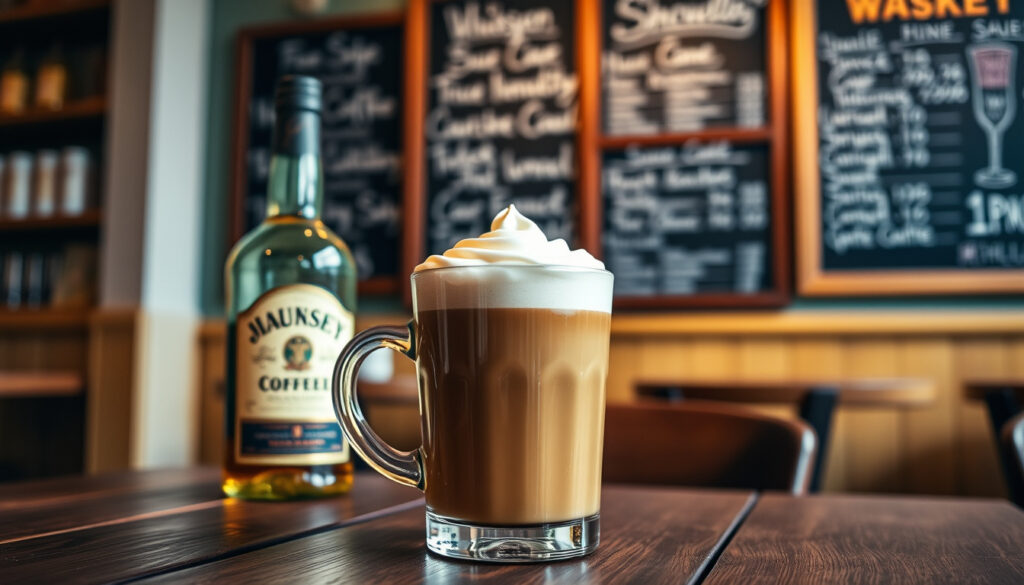
Irish coffee isn’t just a tourist novelty — it’s a national drink with a real origin story. The combination of hot coffee, Irish whiskey, sugar, and cream was first served in 1943 at Foynes airbase in County Limerick by chef Joe Sheridan. Today, you can find authentic versions across the island.
Top Irish coffee spots in Dublin (based on Yelp top 10)
- Copper + Straw (14-18 Aston Quay, Temple Bar) tops the list with a 4.9/5 rating.
- Lovinspoon ranks #2 with 4.7/5 from 598 reviews.
- Vice Coffee on Middle Abbey St doubles as a music venue and has an award-winning drink menu, according to travel blogs (Traverse Blog (travel publication)).
Traditional Irish coffee ingredients and history
- Authentic Irish coffee uses: freshly brewed coffee, Irish whiskey (typically Jameson or Bushmills), brown sugar, and lightly whipped cream poured over the back of a spoon (Foynes Flying Boat Museum (primary source)). The cream must float on top, not mix in.
How to pronounce ‘cup of coffee’ in Irish (caife)
- The Irish word for coffee is caife (pronounced “kaf-feh”). “Cup of coffee” is cupán caife (Teanglann (Irish language dictionary)).
Many pubs serve a sweet, pre-mixed version that barely resembles the original. Ask for “traditional Irish coffee” and check that the cream is unsweetened and floating — if it sinks, you’ve been served a shortcut.
The pattern: the best Irish coffee comes from places that respect the 1943 original, not from pubs cutting corners with pre-mixed syrup.
What is the difference between a café and a coffee shop?
The line between a café and a coffee shop can be blurry, but there are real structural differences in seating, menu, and service style. We break them down below.
Four key contrasts, one pattern: cafés emphasize lingering over meals, while coffee shops prioritize speed and takeaway.
| Feature | Café | Coffee Shop |
|---|---|---|
| Food menu | Full meals, breakfast/brunch, pastries made on-site | Limited grab-and-go items, pre-packaged snacks |
| Seating & atmosphere | Table service, comfortable chairs, often Wi-Fi and outlets for working | Counter order, minimal seating, designed for quick turnover |
| Service style | Server takes order and brings to table; tips expected | Customer orders at counter, waits for drink, may self-serve |
| Historical origin | European coffee houses (e.g., Café Procope, 1686) where patrons socialized for hours | American-style espresso bars from the mid-20th century focused on speed |
Is Starbucks a café or a coffee shop?
- Starbucks operates as a coffee shop chain: counter service, limited food menu, and a heavy focus on to-go sales. While some locations have comfortable seating, the business model remains quick-service.
Historical context: Café Procope (1686) as the oldest coffee house
- Café Procope in Paris, opened in 1686, is widely recognised as the oldest continuously operating coffee house in the world. It served as a meeting place for Enlightenment thinkers like Voltaire and Rousseau — the original “third place.”
Upsides
- Cafés offer a more relaxed atmosphere for meetings or remote work.
- Coffee shops are faster and cheaper for a quick caffeine fix.
- Both can serve excellent coffee if the beans and barista are good.
Downsides
- Cafés often charge more and have longer wait times.
- Coffee shops may lack food quality and comfortable seating.
- In Ireland, the distinction is sometimes ignored — a “café” may have counter service and a “coffee shop” may have table service.
Which coffee is the most tastiest?
Taste is subjective, but some drinks consistently rank higher in popularity and appreciation. Espresso-based drinks like lattes and cappuccinos are the most commonly favored worldwide, according to coffee industry surveys (Statista (market research)). However, preference varies by region and individual palate.
Subjective taste preferences and popular choices
- In Ireland, filter coffee is less common than in the US; espresso-based drinks dominate. The Irish coffee itself is a beloved classic but more of an occasional treat than a daily drink.
Is flavored coffee safe for diabetics?
- Flavored coffee may contain added sugars, syrups, or artificial sweeteners. Diabetics should check nutrition labels and consult their healthcare provider before choosing flavoured options (Diabetes UK (health charity)).
The catch: taste is personal, but if you have health considerations like diabetes, the choice goes beyond what tastes good.
What is the 2 hour coffee rule?
Two popular rules have emerged around coffee: one about when to drink it for best energy, and one about how to brew it for best flavour. Both are grounded in science and practice.
The 2-hour rule: delaying morning coffee after waking
- The 2-hour rule suggests waiting 90–120 minutes after waking before drinking coffee to improve energy regulation. The idea is that cortisol levels are naturally high upon waking; adding caffeine too early can disrupt the body’s natural alertness cycle (Sleep Foundation (sleep health organization)).
The 15-15-15 rule for coffee brewing
- The 15-15-15 rule is a manual brewing technique: let ground coffee bloom for 15 seconds with a small amount of water, then add 15% of the total brew water, and finally complete the pour. This method ensures even extraction and is advocated by specialty coffee guides (Barista Hustle (coffee education resource)).
If you want to maximize the energizing effect of your morning coffee, wait until mid-morning. And if you’re brewing pour-over at home, the 15-15-15 method can elevate a mediocre bean to a surprisingly good cup.
The pattern: both rules are about timing — one for your body’s chemistry, one for the coffee’s extraction — and mastering either improves your daily cup.
Clarity check: what we know and what remains fuzzy
Confirmed facts
- Irish coffee was invented at Foynes airbase in 1943.
- Café Procope is the oldest coffee house still operating.
What’s unclear
- The exact definition of “café” vs “coffee shop” varies by region and culture.
- Which coffee is “most tastiest” is subjective and not universally agreed upon.
- The two-hour coffee rule is supported by some sleep experts but individual responses to caffeine vary (Sleep Foundation (sleep health organization)).
- Copper + Straw in Dublin is the highest-rated café on Tripadvisor, but user-review data may not reflect broader preferences.
“There are so many cool coffee shops in Dublin — it’s hard to pick a favourite. But for a proper Irish coffee, you need to go somewhere that uses real whiskey and fresh cream, not that bottled syrup stuff.”
— Reddit user on r/irishtourism, discussing coffee spots in Dublin r/irishtourism (community forum)
“The Irish coffee at Copper + Straw was the best I’ve had outside of Foynes itself. Perfectly balanced, not too sweet, and the cream floated like it should.”
— Compilation of Yelp reviews for Irish Coffee in Dublin
For anyone searching “coffee places near me” in Ireland, the reality is clear: the country is in the middle of a coffee renaissance with over 3,000 shops to choose from. Whether you’re after a quick espresso from a chain or a leisurely Irish coffee in a historic pub, the quality has never been higher. For the Irish coffee lover, the choice is simple: seek out independent specialists for authenticity, or stick with the chains for predictability — but don’t expect to find a perfect traditional Irish coffee at a Starbucks.
For a deeper look at one of Ireland’s hidden coffee gems, check out Mullingars top-rated cafés that consistently earn high marks from locals and visitors alike.
Frequently asked questions
How do I find coffee places near me that are open now?
Use Google Maps with the “open now” filter, or check dedicated apps like Yelp and Tripadvisor which show real-time hours for most Irish coffee shops.
What are the best coffee chains in Ireland?
Insomnia Coffee Company, Costa Coffee, and Starbucks are the most widespread chains. Independent chains like Butlers Chocolate Café and Coffee Angel are also popular in Dublin (Insomnia Coffee (chain website)).
Do Irish coffee shops offer dairy-free milk options?
Yes, most modern coffee shops in Ireland offer oat, almond, soy, and coconut milk. Oat milk has become especially popular due to its neutral taste and frothing properties.
What is the average price of a coffee in Ireland?
A standard latte or cappuccino costs between €3.00 and €4.00 in cities like Dublin and Cork. Specialty or pour-over options may cost €4.50–€6.00 (Numbeo (cost-of-living database)).
Are there coffee shops near major tourist attractions in Dublin?
Yes — Temple Bar, Grafton Street, and Trinity College area have dozens of coffee shops within a 5-minute walk. Copper + Straw (Aston Quay) is right beside the river Liffey and close to Temple Bar.
Can I find specialty coffee (e.g., pour-over) in Ireland?
Absolutely. Shops like Filter (Cork), Vice Coffee (Dublin), and Ponaire Coffee (Limerick) specialize in pour-over, Aeropress, and single-origin beans. Indy Coffee Guide No3 lists over 100 such locations.
What is the tipping etiquette in Irish coffee shops?
Tipping is not mandatory. If you receive table service, rounding up the bill or leaving €1–€2 is appreciated. At counter-service coffee shops, tips are rarely expected (Tripadvisor (travel etiquette)).
How do I order an Irish coffee in a local pub?
Ask for an “Irish coffee” — most pubs will know. To ensure authenticity, specify “traditional” and request that the cream be poured over the back of a spoon so it floats. If they bring you a pre-mixed bottled version, send it back.
More related posts
 Signs of Skin Cancer: Early Detection & Warning Signs
 List of Law & Order: SVU Episodes: Complete Guide (Seasons 1-27)
 Best Movies on Amazon Prime – Top 2024 Releases Free Now
 How to Make Netherite Armor in Minecraft: Step-by-Step
 Kevin Porter Jr Stats: Bucks Highs, Career & Injury
 Amex Blue Cash Everyday Review: Pros, Cons & Verdict
 Taylor Swift: The Eras Tour – Record Revenue and Bonuses
 Mooyah Burgers Livermore Opening – Hours, Menu, Location Guide